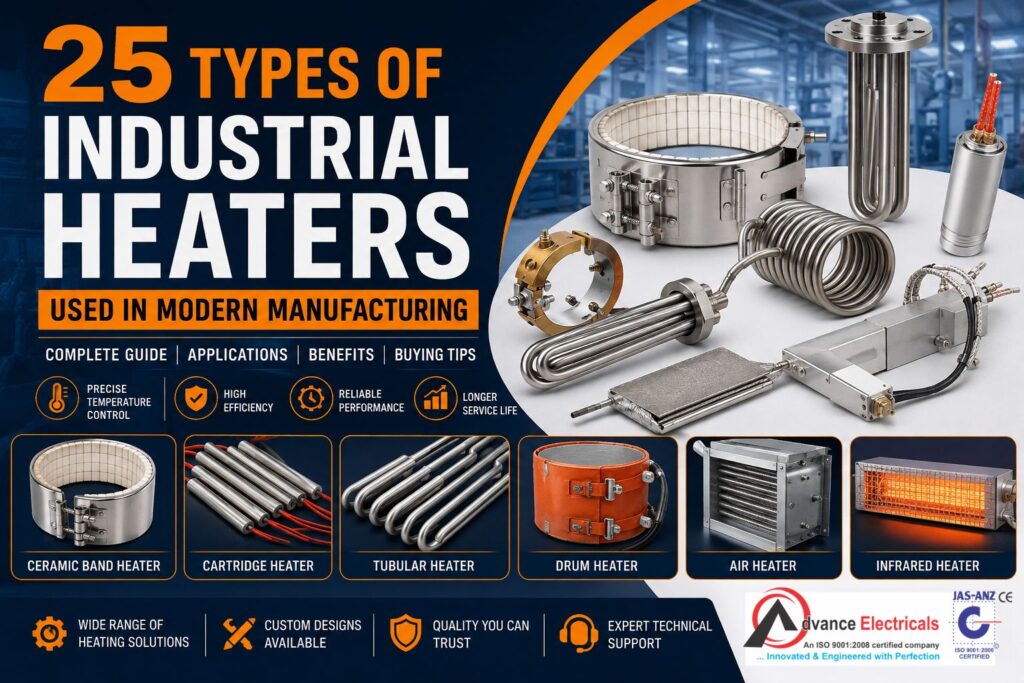
Industrial heating is one of the most critical processes in modern manufacturing. From plastic processing and packaging to pharmaceuticals, food production, chemical plants, automotive components, aerospace, and textile manufacturing, industrial heaters ensure precise temperature control for consistent production quality.
Choosing the right industrial heater is not just about generating heat—it directly impacts product quality, production efficiency, machine life, energy consumption, and maintenance costs. With the growing demand for energy-efficient and high-performance heating solutions, manufacturers now have access to a wide range of industrial heaters designed for specific applications.
This guide explains the 25 most commonly used industrial heaters in modern manufacturing. Whether you are an OEM machine builder, plant engineer, maintenance manager, or purchasing professional, this article will help you understand the working principle, applications, advantages, and ideal use cases of each heater type.
What is an Industrial Heater?
An industrial heater is an electrical or process heating device designed to generate and transfer heat for manufacturing operations. Unlike domestic heating equipment, industrial heaters are engineered to operate continuously under demanding conditions while delivering precise and reliable temperature control.
Industrial heaters are used to:
- Heat air, liquids, gases, and metal surfaces
- Maintain process temperatures
- Improve production efficiency
- Reduce energy consumption
- Prevent moisture and condensation
- Support automated manufacturing systems
They are available in various designs depending on the heating method, operating temperature, and application requirements.
Why Choosing the Right Industrial Heater Matters
Selecting the wrong heater can result in:
- Uneven heating
- Higher electricity costs
- Frequent heater failures
- Machine downtime
- Product quality issues
- Increased maintenance expenses
The right industrial heater provides:
- Uniform heat distribution
- Better energy efficiency
- Longer service life
- Improved process control
- Lower operating costs
- Higher production output
This is why working with an experienced Industrial Heater Manufacturer is essential when selecting heating solutions for industrial machinery.
Factors to Consider Before Selecting an Industrial Heater
Before choosing an industrial heater, evaluate the following factors:
- Operating temperature
- Heating medium (Air, Water, Oil, Metal)
- Available installation space
- Voltage and wattage requirements
- Heat-up time
- Temperature control accuracy
- Environmental conditions
- Duty cycle
- Maintenance requirements
- Energy efficiency
Each industrial process has different heating requirements, so selecting the correct heater improves productivity and extends equipment life.
25 Types of Industrial Heaters
1. Cartridge Heater
Cartridge heaters are compact cylindrical heaters designed for installation inside drilled holes. They provide rapid heat transfer and precise temperature control.
Common Applications
- Plastic Injection Moulding
- Packaging Machines
- Medical Equipment
- Laboratory Equipment
- Die Casting
- Hot Runner Systems
Advantages
- High watt density
- Fast heating
- Compact design
- Uniform temperature
- Long service life
2. Tubular Heater
Tubular heaters are among the most versatile industrial heating elements. They can be straight or custom-bent to suit specific applications.
Applications
- Water Heating
- Oil Heating
- Air Heating
- Ovens
- Tanks
- Boilers
Advantages
- Easy installation
- Flexible designs
- Excellent durability
- Suitable for harsh environments
3. Coil Heater
Coil heaters are specially designed for applications requiring high temperatures in limited spaces.
Applications
- Injection Moulding Machines
- Hot Runner Nozzles
- Packaging Equipment
Advantages
- Rapid heat transfer
- Flexible construction
- High operating temperature
- Excellent efficiency
4. Hot Runner Heater
Hot Runner Heaters are precision heating elements used in plastic injection moulding systems.
Applications
- Plastic Processing
- Injection Moulding
- Hot Runner Systems
Advantages
- Uniform heating
- Reduced material waste
- Improved moulding quality
- Better temperature control
5. Ceramic Band Heater
Ceramic Band Heaters provide efficient barrel heating for plastic processing machinery.
Applications
- Plastic Extrusion
- Injection Moulding
- Blow Moulding
Advantages
- High insulation
- Lower power consumption
- Longer operating life
- Uniform heating
6. Mica Band Heater
Mica Band Heaters are economical heating solutions designed for medium-temperature industrial applications.
Applications
- Plastic Machinery
- Food Equipment
- Packaging Machines
Advantages
- Cost-effective
- Quick installation
- Lightweight
- Uniform heating
7. Nozzle Heater
Nozzle heaters provide localized heating for injection moulding nozzles and hot runner systems.
Applications
- Plastic Injection Moulding
- Packaging Equipment
- Hot Runner Systems
Advantages
- Precise temperature control
- Compact size
- Rapid heating
- High reliability
Why Modern Industries Use Different Types of Industrial Heaters
No single industrial heater can meet the heating requirements of every manufacturing process. For example, a cartridge heater is ideal for localized heating inside metal components, while a tubular heater is better suited for heating liquids or air. Similarly, ceramic band heaters are preferred for plastic processing machinery, whereas hot runner heaters are specifically designed for precision plastic injection moulding.
Selecting the correct heater improves energy efficiency, minimizes downtime, and extends equipment life. This is why manufacturers often use multiple heater types within the same production facility.
Expert Insight
At Advance Electricals, we manufacture a wide range of industrial heating solutions tailored to the requirements of OEMs, machine builders, and industrial users. Our engineering team helps customers select the most suitable heater based on operating temperature, application, power requirements, and machine design. Choosing the correct heater from the beginning can significantly reduce maintenance costs and improve production efficiency.
8. Strip Heater
Strip heaters are flat electric heating elements designed for direct surface heating. They are commonly mounted on flat metal surfaces using clamps or bolts, making them an ideal solution for machinery requiring uniform heat across plates, dies, and molds.
Working Principle
A resistance wire embedded within insulated materials generates heat, which is transferred directly to the metal surface.
Common Applications
- Packaging Machines
- Heat Sealing Equipment
- Food Processing Machinery
- Plastic Processing Machines
- Printing Machines
- Metal Dies
- Industrial Ovens
Advantages
- Uniform surface heating
- Easy installation
- Compact design
- Low maintenance
- High thermal efficiency
Why Choose Strip Heaters?
Strip heaters are an excellent option when large flat surfaces require consistent temperatures without occupying excessive installation space.
9. Air Heater
Industrial Air Heaters are designed to heat moving or stationary air efficiently. They are widely used in industrial drying systems, HVAC equipment, ducts, ovens, and process heating applications.
Working Principle
Electric heating elements warm the air passing over them, producing controlled hot airflow for industrial processes.
Common Applications
- Drying Systems
- Industrial Ovens
- Paint Booths
- Textile Dryers
- Pharmaceutical Drying
- HVAC Systems
- Food Processing
Advantages
- Fast heating
- Uniform airflow
- High energy efficiency
- Reliable temperature control
- Continuous operation
Benefits
Industrial Air Heaters improve production speed while reducing drying time and energy consumption.
10. Immersion Heater
Immersion heaters are specifically designed to heat liquids by direct immersion. They are one of the most efficient heating methods because almost all generated heat is transferred directly into the liquid.
Working Principle
The heating element is immersed in water, oil, chemicals, or other liquids, providing rapid and efficient heat transfer.
Applications
- Water Heating
- Oil Heating
- Chemical Tanks
- Food Processing
- Pharmaceutical Plants
- Process Industries
Advantages
- Excellent heat transfer
- High efficiency
- Easy installation
- Low maintenance
- Suitable for continuous operation
Available Configurations
- Flanged Immersion Heaters
- Screw Plug Immersion Heaters
- Over-the-Side Heaters
- Custom Industrial Designs
11. Furnace Heater
Furnace heaters are high-temperature heating elements used in industrial furnaces, kilns, ovens, and heat treatment equipment.
Working Principle
These heaters generate high temperatures required for metal processing, heat treatment, annealing, sintering, and material testing.
Applications
- Heat Treatment Furnaces
- Industrial Ovens
- Ceramic Industry
- Steel Industry
- Glass Industry
- Laboratory Furnaces
Advantages
- Extremely high operating temperatures
- Excellent durability
- Long service life
- Reliable performance
- Uniform heat distribution
Typical Industries
- Metallurgy
- Aerospace
- Automotive
- Tool Manufacturing
- Foundries
12. Panel Space Heater
Electrical panels often suffer from moisture buildup and condensation, leading to corrosion, electrical faults, and equipment failure. Panel Space Heaters are designed to prevent these problems by maintaining a stable internal temperature.
Working Principle
The heater gently warms the air inside electrical enclosures, preventing condensation from forming.
Applications
- Electrical Panels
- Control Cabinets
- PLC Panels
- Switchgear
- Outdoor Electrical Enclosures
- Automation Systems
Advantages
- Prevents condensation
- Improves equipment life
- Reduces maintenance
- Easy installation
- Energy efficient
Why Panel Space Heaters Matter
For industries operating in humid or outdoor environments, panel space heaters significantly reduce downtime caused by moisture-related electrical failures.
13. Drum Heater
Drum heaters are designed to heat and maintain the temperature of liquids, oils, chemicals, waxes, adhesives, and food ingredients stored in drums and barrels.
Working Principle
The heater wraps around or surrounds the drum, transferring heat evenly to the contents.
Applications
- Chemical Industry
- Food Processing
- Paint Manufacturing
- Adhesive Industry
- Oil Industry
- Pharmaceutical Manufacturing
Advantages
- Uniform heating
- Prevents material solidification
- Reduces processing time
- Easy installation
- Portable solution
Available Types
- Silicone Drum Heater
- Metal Drum Heater
- Insulated Drum Heater
- Jacket Type Drum Heater
14. Infrared Heater
Infrared heaters transfer heat through electromagnetic infrared radiation instead of directly heating the surrounding air. This method provides rapid, efficient, and targeted heating.
Working Principle
Infrared radiation is absorbed by the object’s surface, converting radiant energy into heat.
Applications
- Paint Drying
- Powder Coating
- Plastic Forming
- Textile Drying
- Food Processing
- Printing Industry
Advantages
- Instant heating
- Energy efficient
- No moving air required
- Reduced drying time
- Uniform heating
Why Industries Prefer Infrared Heating
Infrared heating minimizes heat loss because energy is directed toward the product instead of the surrounding environment.
15. Casting Heater
Casting heaters are manufactured by embedding heating elements inside cast aluminium, bronze, or brass bodies. They provide highly uniform heating and excellent mechanical strength.
Working Principle
The cast body distributes heat evenly across large surfaces while protecting the heating element.
Applications
- Plastic Processing
- Extrusion Machines
- Blow Moulding
- Die Casting
- Packaging Equipment
Advantages
- Uniform temperature distribution
- Excellent durability
- High mechanical strength
- Long operational life
- Reduced maintenance
Available Materials
- Aluminium Cast Heaters
- Bronze Cast Heaters
- Brass Cast Heaters
Comparison Table (Types 8–15)
| Heater Type | Heating Medium | Temperature Range | Common Applications |
| Strip Heater | Surface | Medium | Packaging, Sealing, Ovens |
| Air Heater | Air | High | Drying, HVAC, Ovens |
| Immersion Heater | Liquid | High | Tanks, Water, Oil |
| Furnace Heater | Furnace Chamber | Very High | Heat Treatment |
| Panel Space Heater | Enclosure Air | Low-Medium | Electrical Panels |
| Drum Heater | Drum Surface | Medium | Chemicals, Oils |
| Infrared Heater | Radiant Heat | High | Drying, Coating |
| Casting Heater | Metal Surface | High | Extrusion, Plastic Processing |
Expert Insight
Different industrial processes require different heating technologies. Selecting a heater based solely on price often results in poor efficiency, increased downtime, and higher operating costs. At Advance Electricals, our engineering team evaluates application requirements such as operating temperature, heating medium, duty cycle, installation space, and environmental conditions before recommending the most suitable heating solution.
Whether you require air heating, liquid heating, enclosure heating, or precision surface heating, choosing the right industrial heater ensures better productivity, lower maintenance costs, and longer equipment life.
16. Brass Coil Heater
Brass Coil Heaters are designed for applications requiring high thermal conductivity, mechanical strength, and extended service life. These heaters are commonly used in plastic injection molding machines where consistent nozzle temperatures are critical.
Working Principle
A high-performance coil heating element is enclosed within a brass casing. The brass body distributes heat evenly while protecting the internal heating element from mechanical damage.
Common Applications
- Plastic Injection Moulding
- Hot Runner Systems
- Packaging Machinery
- Precision Heating Equipment
Advantages
- Excellent heat transfer
- Durable brass construction
- Uniform temperature distribution
- Long operational life
- Reduced maintenance
17. Water Heater Element
Water Heater Elements are immersion-type electric heating elements designed to heat water efficiently in industrial and commercial systems.
Working Principle
The element converts electrical energy into heat, which is transferred directly to the surrounding water through conduction.
Applications
- Industrial Water Tanks
- Boilers
- Commercial Water Heating Systems
- Food Processing
- Pharmaceutical Plants
Advantages
- High efficiency
- Quick heating
- Corrosion-resistant materials
- Long service life
- Low maintenance
18. Thermocouple
Although a thermocouple is not a heater, it is an essential temperature sensor used with industrial heating systems to monitor and control process temperatures accurately.
Applications
- Cartridge Heaters
- Coil Heaters
- Furnaces
- Industrial Ovens
- Plastic Machinery
- Hot Runner Systems
Advantages
- Fast temperature response
- High accuracy
- Wide temperature range
- Reliable operation
- Easy integration with temperature controllers
19. Manifold Heater
Manifold heaters are precision heating elements designed specifically for hot runner manifolds used in plastic injection molding systems.
Applications
- Injection Moulding Machines
- Plastic Components Manufacturing
- Automotive Plastic Parts
- Medical Plastic Components
Advantages
- Uniform manifold heating
- Reduced material waste
- Better temperature consistency
- Improved product quality
20. Corrugation Heater
Corrugation heaters are specially designed heating elements used in corrugated pipe and sheet manufacturing machines.
Applications
- Corrugated Pipe Machines
- Plastic Extrusion Lines
- Packaging Industry
- Industrial Plastic Products
Advantages
- Uniform heating
- High productivity
- Long operating life
- Consistent process temperature
21. Silicone Rubber Heater
Silicone Rubber Heaters are flexible electric heaters manufactured using reinforced silicone insulation. They are ideal for heating curved or irregular surfaces.
Applications
- Medical Equipment
- Laboratory Instruments
- Food Processing
- Battery Heating
- Freeze Protection
- Electronic Enclosures
Advantages
- Flexible construction
- Moisture resistant
- Lightweight
- Uniform heating
- Easy installation
22. Quartz Heater
Quartz heaters use quartz tubes to generate radiant heat and are commonly selected where rapid heating is required.
Applications
- Drying Systems
- Printing Industry
- Paint Curing
- Textile Machinery
- Laboratory Equipment
Advantages
- Instant heat generation
- High efficiency
- Clean heating
- Long service life
- Low maintenance
23. Ceramic Infrared Heater
Ceramic Infrared Heaters produce infrared radiation that directly heats objects rather than the surrounding air.
Applications
- Plastic Thermoforming
- Powder Coating
- Food Processing
- Drying Systems
- Printing Industry
Advantages
- Excellent energy efficiency
- Uniform radiant heating
- Reduced drying time
- Suitable for continuous production
24. Flexible Heating Jacket
Flexible Heating Jackets are removable insulation systems integrated with electric heating elements. They improve energy efficiency while maintaining consistent process temperatures.
Applications
- Plastic Processing Machines
- Barrels
- Pipes
- Valves
- Chemical Tanks
- Process Equipment
Advantages
- Significant energy savings
- Improved operator safety
- Reduced heat loss
- Easy installation and removal
- Lower operating costs
25. Custom Industrial Heating Solutions
Modern manufacturing often requires heaters designed specifically for unique equipment, operating conditions, and production requirements.
Custom heating solutions are engineered according to:
- Voltage
- Wattage
- Diameter
- Length
- Temperature Range
- Installation Method
- Mounting Style
- Environmental Conditions
Industries Served
- Automotive
- Plastic Processing
- Pharmaceutical
- Food Manufacturing
- Packaging
- Aerospace
- Textile
- Electronics
- Chemical Processing
Benefits
- Optimized performance
- Longer equipment life
- Higher energy efficiency
- Lower maintenance costs
- Improved production quality
Comparison Table: Types 16–25
| Heater Type | Heating Method | Primary Application | Key Benefit |
| Brass Coil Heater | Conduction | Plastic Machinery | High thermal conductivity |
| Water Heater Element | Immersion | Water Heating | Fast heat transfer |
| Thermocouple | Temperature Sensing | All Heating Systems | Accurate temperature control |
| Manifold Heater | Conduction | Hot Runner Systems | Uniform manifold heating |
| Corrugation Heater | Surface Heating | Corrugation Machines | Stable process temperature |
| Silicone Rubber Heater | Surface Heating | Tanks & Equipment | Flexible installation |
| Quartz Heater | Radiant Heating | Drying & Curing | Instant heating |
| Ceramic Infrared Heater | Infrared Radiation | Thermoforming | Energy efficient |
| Flexible Heating Jacket | Surface Heating | Barrels & Pipes | Energy savings |
| Custom Heating Solution | Customized | OEM Machinery | Application-specific design |
Industrial Heater Selection by Industry
| Industry | Recommended Heater Types |
| Plastic Processing | Cartridge, Coil, Ceramic Band, Hot Runner, Nozzle, Brass Coil |
| Packaging | Strip, Cartridge, Air Heater |
| Food Processing | Immersion, Air Heater, Tubular Heater |
| Pharmaceutical | Cartridge, Air Heater, Silicone Rubber Heater |
| Chemical Processing | Immersion, Drum Heater, Air Heater |
| Automotive | Furnace Heater, Cartridge Heater, Infrared Heater |
| Textile | Air Heater, Infrared Heater, Quartz Heater |
| Electrical Panels | Panel Space Heater |
| Corrugation Industry | Corrugation Heater |
| OEM Machinery | Custom Industrial Heating Solutions |
Expert Recommendation
There is no single industrial heater suitable for every manufacturing process. The ideal heating solution depends on factors such as the heating medium, operating temperature, production speed, installation space, and energy efficiency requirements.
At Advance Electricals, we work with machine manufacturers, OEMs, and industrial users to recommend heating solutions that match their specific process needs. By selecting the right heater from the beginning, businesses can reduce downtime, improve product quality, and lower long-term operating costs.
Complete Industrial Heater Buying Guide
Selecting the right industrial heater is a critical decision that affects production efficiency, energy consumption, product quality, and equipment lifespan. Every manufacturing process has unique heating requirements, so understanding the key selection factors helps avoid costly mistakes.
1. Understand Your Heating Application
Before purchasing an industrial heater, identify exactly what needs to be heated.
Examples include:
- Air
- Water
- Oil
- Chemicals
- Metal Dies
- Plastic Barrels
- Moulds
- Hot Runner Systems
- Electrical Panels
Different applications require different heating technologies.
2. Determine the Required Temperature
Every heater has a recommended operating temperature range.
| Temperature Range | Suitable Heater Types |
| Up to 150°C | Panel Space Heater, Silicone Heater |
| 150–300°C | Strip Heater, Drum Heater, Air Heater |
| 300–500°C | Cartridge Heater, Coil Heater, Ceramic Band Heater |
| Above 500°C | Furnace Heater, Infrared Heater, Custom Industrial Heater |
Selecting the correct temperature rating improves efficiency and extends heater life.
3. Choose the Correct Heating Method
| Heating Method | Recommended Heater |
| Surface Heating | Strip Heater, Band Heater, Silicone Heater |
| Liquid Heating | Immersion Heater |
| Air Heating | Air Heater |
| Direct Metal Heating | Cartridge Heater |
| Radiant Heating | Infrared Heater, Quartz Heater |
| Plastic Processing | Coil Heater, Hot Runner Heater |
4. Evaluate Energy Efficiency
Energy-efficient heaters help reduce operational costs over time. Look for:
- Uniform heat distribution
- High-quality insulation
- Low heat loss
- Accurate temperature control
- Optimized watt density
5. Consider Maintenance Requirements
Select heaters that are:
- Easy to install
- Easy to replace
- Resistant to corrosion
- Suitable for continuous operation
- Backed by technical support
Common Mistakes When Selecting an Industrial Heater
Avoid these common errors:
- Choosing the wrong heater type
- Ignoring operating temperature limits
- Selecting incorrect voltage or wattage
- Poor installation practices
- Inadequate temperature control
- Not considering environmental conditions
- Choosing only on price instead of performance
- Skipping preventive maintenance
- Not consulting the manufacturer for custom applications
These mistakes often lead to premature heater failure, higher energy costs, and production downtime.
Maintenance Tips for Industrial Heaters
Proper maintenance improves heater performance and extends service life.
Daily Inspection
- Check temperature stability
- Inspect electrical connections
- Look for physical damage
- Ensure controllers are functioning correctly
Weekly Inspection
- Clean heater surfaces
- Check terminals
- Inspect lead wires
- Verify sensor readings
Monthly Inspection
- Measure insulation resistance
- Check heater resistance
- Inspect mounting condition
- Calibrate temperature controllers
Annual Maintenance
- Replace worn components
- Inspect control panels
- Verify safety systems
- Review heater performance under load
A preventive maintenance schedule helps minimize unexpected downtime and ensures consistent production.
Why Choose Advance Electricals?
Industrial heating requirements vary from one application to another. At Advance Electricals, we understand that selecting the right heater is just as important as manufacturing it.
Our engineering team works closely with customers to recommend heating solutions based on operating temperature, heating medium, machine design, and production requirements.
Our Product Range
- High Density Cartridge Heaters
- Coil Heaters
- Tubular Heaters
- Ceramic Band Heaters
- Nozzle Heaters
- Strip Heaters
- Immersion Heaters
- Furnace Heaters
- Infrared Heaters
- Drum Heaters
- Panel Space Heaters
- Air Heaters
- Thermocouples
- Manifold Heaters
- Corrugation Heaters
- Brass Coil Heaters
- Water Heater Elements
- Insulation Jackets for Plastic Machines
Why Industries Trust Advance Electricals
- Manufacturer with industry experience
- Custom-engineered heating solutions
- High-quality materials
- Precision manufacturing
- Consistent product performance
- Technical application support
- Fast production and delivery
- Solutions for OEMs and industrial users
Conclusion
Industrial heaters are the backbone of modern manufacturing, enabling precise temperature control across industries such as plastic processing, packaging, pharmaceuticals, food processing, chemicals, automotive, and heavy engineering. Each heater type is designed for a specific purpose, and selecting the right solution can improve production efficiency, reduce energy consumption, and extend equipment life.
Understanding the characteristics, applications, and advantages of different industrial heaters helps businesses make informed decisions and optimize their manufacturing processes.
Whether your requirement is for localized heating, air heating, liquid heating, radiant heating, or a custom-engineered solution, partnering with an experienced manufacturer ensures long-term reliability and performance.
Contact Advance Electricals
If you’re looking for a trusted Industrial Heater Manufacturer in India, Advance Electricals offers a comprehensive range of standard and customized industrial heating solutions. Our team can help you choose the right heater based on your application, operating temperature, voltage, wattage, and machine requirements.
Get in touch with our technical experts today to discuss your industrial heating needs and find the most suitable solution for your business.
Frequently Asked Questions (FAQs)
An industrial heater is a device that converts electrical energy into heat for manufacturing processes such as plastic processing, drying, melting, sealing, and temperature control.
Cartridge Heaters, Coil Heaters, Ceramic Band Heaters, Nozzle Heaters, and Hot Runner Heaters are commonly used in plastic processing machinery.
Immersion Heaters are the preferred solution for heating water, oil, chemicals, and other industrial liquids.
The most energy-efficient heater depends on the application. Cartridge Heaters, Infrared Heaters, and Immersion Heaters are known for high thermal efficiency when correctly selected and installed.
Service life depends on operating temperature, watt density, installation quality, maintenance, voltage stability, and environmental conditions.
Yes. Manufacturers can customize voltage, wattage, dimensions, heating length, sheath material, mounting style, and electrical connections based on application requirements.
Visual inspections should be carried out regularly, while electrical testing and preventive maintenance should follow the manufacturer’s recommendations and the operating conditions of the equipment.
Accurate temperature control helps improve product quality, reduce energy consumption, prevent overheating, and extend heater life.
Industrial heaters are widely used in:
Plastic Processing
Packaging
Food Processing
Pharmaceutical
Chemical
Automotive
Textile
Electronics
Printing
Aerospace
Metal Processing
Choose a manufacturer that offers application engineering support, custom manufacturing, quality testing, reliable delivery, and responsive after-sales service.