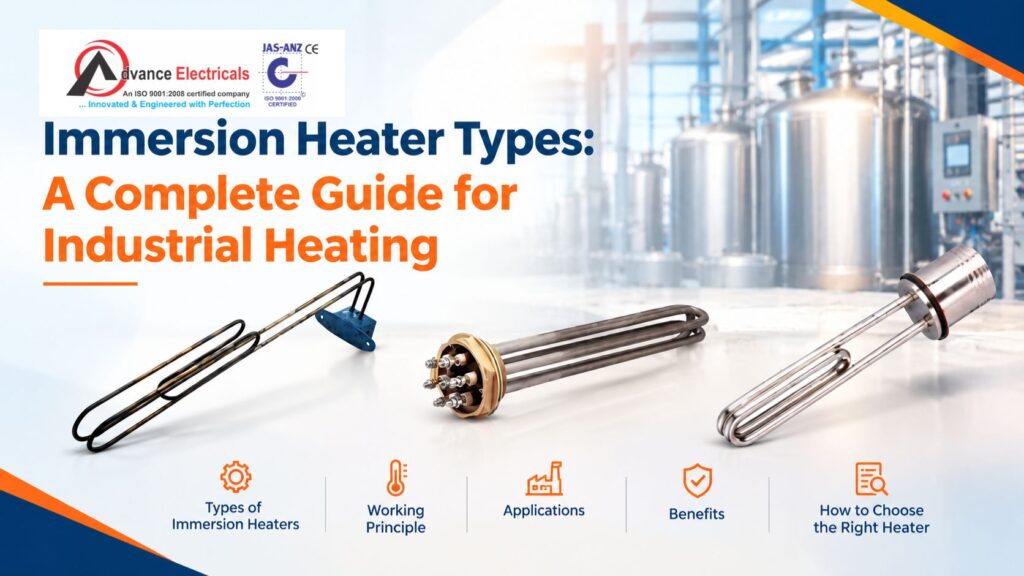
Immersion heaters are widely used in industrial applications where liquids need to be heated efficiently and consistently. They are commonly used for heating water, oil, chemicals, tanks, process fluids, and other liquids.
Choosing the right immersion heater is important because the heater type, material, wattage, temperature, and installation method can directly affect heating performance and service life.
In this complete guide, we will explain the different immersion heater types, their working principle, applications, benefits, and the key factors to consider when selecting one for an industrial heating application.
What Is an Immersion Heater?
An immersion heater is an electrical heating element designed to heat a liquid by being directly immersed in it.
When electrical current passes through the heating element, electrical energy is converted into heat. This heat is transferred directly to the surrounding liquid.
Immersion heaters are available in different shapes, materials, sizes, wattages, and configurations depending on the liquid being heated and the operating conditions.
How Does an Immersion Heater Work?
The working principle of an immersion heater is relatively simple.
- Electrical power is supplied to the heating element.
- The resistance element generates heat.
- Heat is transferred from the element surface to the surrounding liquid.
- The liquid gradually reaches the required temperature.
- A thermostat or temperature controller can be used to maintain the desired temperature.
Because the heating element is directly immersed in the liquid, immersion heating can provide efficient and controlled heat transfer.
Different Types of Immersion Heaters
There are several types of immersion heaters used across industrial applications. The right type depends on the liquid, tank design, temperature requirements, and installation method.
1. Screw Plug Immersion Heaters
Screw plug immersion heaters are fitted into a threaded opening in a tank, vessel, or pipe.
They generally consist of tubular heating elements attached to a threaded screw plug. The heater is installed through a suitable opening, allowing the heating elements to remain immersed in the liquid.
Applications
- Water heating
- Oil heating
- Storage tanks
- Process tanks
- Chemical processing
- Industrial fluid heating
Benefits
- Easy installation
- Compact design
- Suitable for many industrial tanks
- Available in different wattages
- Convenient for maintenance and replacement
2. Flange Immersion Heaters
Flange immersion heaters use a flange for mounting and are commonly used for larger tanks and industrial vessels.
The heating elements are attached to a flange that is securely mounted to the tank.
Applications
- Large water tanks
- Oil storage tanks
- Chemical tanks
- Process heating systems
- Industrial boilers and vessels
Benefits
- Suitable for high-capacity heating
- Multiple heating elements can be incorporated
- Strong mechanical mounting
- Flexible heating capacity
- Suitable for large industrial applications
3. Over-the-Side Immersion Heaters
Over-the-side immersion heaters are installed from the top or side of a tank without requiring a heater opening at the bottom.
The heating section is placed inside the tank while the electrical connection remains outside.
Applications
- Open tanks
- Chemical processing
- Plating tanks
- Water treatment
- Cleaning tanks
- Process liquid heating
Benefits
- Easy to install and remove
- Suitable for tanks where bottom mounting is difficult
- Convenient for maintenance
- Useful for temporary or flexible heating requirements
4. Circulation Immersion Heaters
Circulation heaters are designed to heat liquids as they flow through a pipe, chamber, or circulation system.
The heating elements are installed inside a vessel through which the fluid passes.
Applications
- Water circulation systems
- Oil heating
- Process fluid heating
- Chemical processing
- Heat transfer systems
Benefits
- Controlled fluid heating
- Suitable for continuous processes
- Compact installation
- Efficient heat transfer
- Easy integration with circulation systems
5. Tubular Immersion Heaters
Tubular immersion heaters use tubular heating elements that can be manufactured in different shapes and sizes according to application requirements.
These heaters are widely used because tubular elements can be designed for different voltages, wattages, lengths, and mounting configurations.
Applications
- Water heating
- Oil heating
- Industrial tanks
- Process equipment
- Chemical applications
- Heating systems
Benefits
- Strong construction
- Flexible design
- Different sheath materials available
- Suitable for various liquids
- Good heating performance
6. Tank Immersion Heaters
Tank immersion heaters are specifically designed for heating liquids stored inside industrial tanks.
They can be customized according to tank size, liquid type, required temperature, and heating capacity.
Applications
- Water tanks
- Oil tanks
- Chemical tanks
- Process tanks
- Storage vessels
Tank heaters can be designed with suitable mounting arrangements and temperature control systems to achieve consistent heating.
Immersion Heater Sheath Materials
The material surrounding the heating element is an important consideration when selecting an immersion heater.
Stainless Steel
Stainless steel is commonly used for water and many industrial applications because of its strength and corrosion resistance.
Incoloy
Incoloy materials can be suitable for demanding high-temperature applications and environments where greater resistance is required.
Titanium
Titanium immersion heaters are often considered for applications involving aggressive or corrosive liquids.
Copper
Copper provides good thermal conductivity and can be used in suitable water-heating applications. However, compatibility with the liquid should always be considered before selection.
The correct sheath material depends mainly on the chemical properties of the liquid, operating temperature, and required service life.
Industrial Applications of Immersion Heaters
Immersion heaters are used in many industries because they can provide direct and controlled heating.
Water Heating
Immersion heaters are commonly used for heating water in tanks, vessels, and industrial processes.
Oil Heating
Specially designed immersion heaters can be used to heat different types of industrial oils and heat-transfer fluids.
Chemical Processing
In chemical industries, heaters may be used for maintaining process liquids at specific temperatures.
Food Processing
Suitable immersion heating systems can be used for controlled heating of liquids used in food-processing operations.
Pharmaceutical Industry
Immersion heaters can be used in process equipment where accurate temperature control is required.
Plastic and Manufacturing Industries
Industrial immersion heaters can help maintain the temperature of process liquids used in manufacturing operations.
Water Treatment
They can also be used for heating water and processing fluids in various water-treatment applications.
Benefits of Using Immersion Heaters
Direct Heat Transfer
Because the heating element is directly immersed in the liquid, heat can be transferred efficiently to the surrounding medium.
Precise Temperature Control
Immersion heaters can be combined with thermostats, thermocouples, and digital temperature controllers for better temperature regulation.
Customizable Design
Industrial immersion heaters can be manufactured according to specific requirements such as length, diameter, wattage, voltage, and mounting arrangement.
Easy Installation
Depending on the design, immersion heaters can be installed using screw plugs, flanges, or over-the-side mounting arrangements.
Suitable for Different Applications
With the correct material and design, immersion heaters can be used for water, oil, chemicals, and various process fluids.
How to Choose the Right Immersion Heater?
Selecting an immersion heater should not be based only on wattage. Several factors need to be considered.
1. Type of Liquid
First, identify the liquid that needs to be heated.
Water, oil, chemicals, and other fluids have different heating requirements and material compatibility considerations.
2. Required Temperature
Determine the required operating temperature of the liquid. The heater should be suitable for the expected operating conditions.
3. Required Heating Capacity
The required wattage depends on factors such as:
- Volume of liquid
- Starting temperature
- Desired final temperature
- Heating time
- Heat loss
- Fluid properties
Selecting the correct wattage helps achieve the required heating performance.
4. Heater Material
Choose the sheath material according to the liquid’s chemical properties and operating environment.
Incorrect material selection can result in corrosion and premature heater failure.
5. Installation Method
Consider how the heater will be installed.
Depending on the tank or process equipment, a screw plug, flange, or over-the-side heater may be more suitable.
6. Temperature Control
For applications requiring accurate heating, consider using a suitable thermostat, thermocouple, or temperature controller.
7. Available Space
The heater’s length, diameter, and mounting arrangement should fit properly inside the tank or heating equipment.
Common Immersion Heater Problems
Even a properly selected heater can develop problems if it is incorrectly installed or operated.
Some common issues include:
- Heater overheating
- Scaling on the heating element
- Corrosion
- Electrical failure
- Poor temperature control
- Heater burnout
- Insufficient heating
- Loose electrical connections
Regular inspection and correct operating conditions can help reduce these problems.
How to Maintain an Immersion Heater
Proper maintenance can improve heater performance and service life.
Check for Scale
Mineral deposits can build up on the heating element, particularly when heating hard water. Excessive scale can reduce heat transfer and cause overheating.
Inspect Electrical Connections
Loose or damaged electrical connections should be identified and corrected by qualified personnel.
Check Temperature Control
Make sure the thermostat, thermocouple, and temperature controller are functioning correctly.
Inspect for Corrosion
Regularly inspect the heater sheath for signs of corrosion or physical damage.
Avoid Dry Running
A heater designed for liquid immersion should not be operated without adequate liquid coverage. Dry operation can cause rapid overheating and heater failure.
Immersion Heater vs Other Industrial Heating Methods
Immersion heaters are particularly useful when the heating requirement involves directly heating a liquid.
Compared with indirect heating methods, immersion heaters can offer:
- Direct heat transfer
- Compact installation
- Easy temperature control
- Flexible mounting options
- Customizable heating capacity
However, the correct heating method depends on the process and application requirements.
Why Choose the Right Immersion Heater Manufacturer?
Working with experienced Immersion Heater Manufacturers can be helpful when an application requires customized dimensions, wattage, materials, or mounting arrangements.
A reliable manufacturer should understand the heating requirements and provide a heater designed according to the application.
Advance Electricals provides industrial heating solutions for different manufacturing and process-heating requirements. Proper heater selection based on the liquid, temperature, wattage, material, and installation method can help improve heating efficiency and service life.
Conclusion
Immersion heaters are an effective solution for heating water, oil, chemicals, and other industrial liquids. Different designs such as screw plug, flange, over-the-side, circulation, and tubular immersion heaters are available for different applications.
Choosing the right heater requires careful consideration of the liquid type, required temperature, wattage, sheath material, installation method, tank size, and temperature control requirements.
With proper selection, installation, and maintenance, an immersion heating system can provide reliable and consistent heating for a wide range of industrial processes.
Frequently Asked Questions (FAQs)
The main types include screw plug immersion heaters, flange immersion heaters, over-the-side immersion heaters, circulation heaters, tubular immersion heaters, and tank immersion heaters.
The best option depends on the tank size, water volume, required temperature, heating time, and installation arrangement. Screw plug and flange heaters are commonly used for industrial water heating.
Yes. Immersion heaters can be designed for oil heating, but the heater wattage, sheath material, surface loading, and operating temperature should be selected according to the specific oil and application.
Consider the liquid type, required temperature, liquid volume, heating time, required wattage, heater material, installation method, and available space before selecting an immersion heater.
Proper heater selection, avoiding dry running, maintaining adequate liquid coverage, controlling temperature, cleaning scale, and regularly inspecting electrical connections can help improve heater life.