
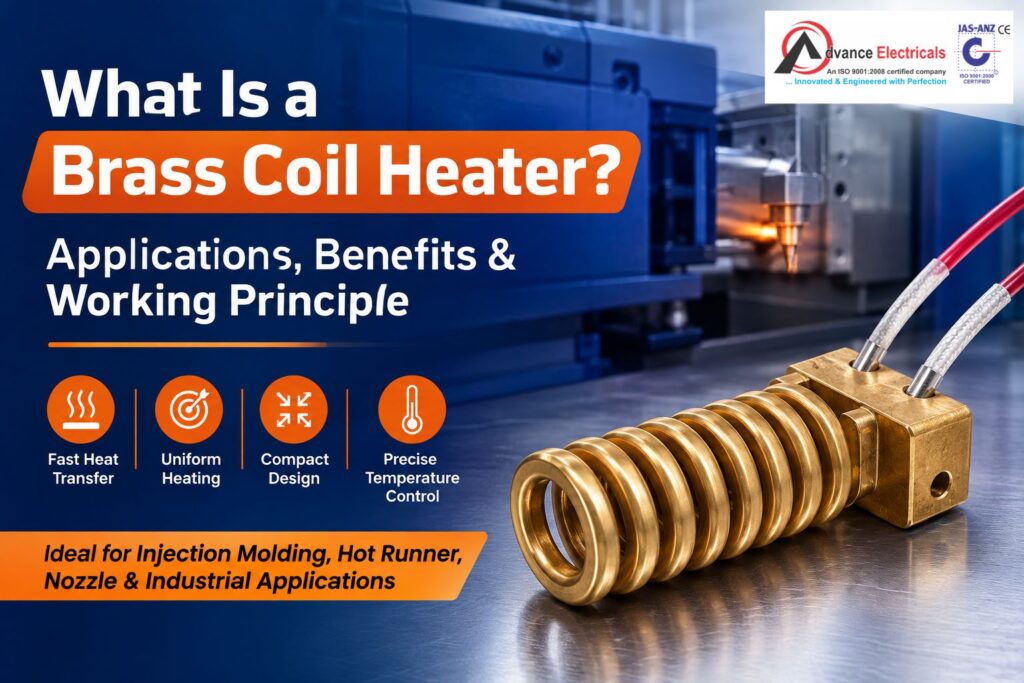
Brass coil heaters are widely used in industries where fast, uniform, and precise heating is required in a compact space. They are especially common in plastic processing, injection molding, extrusion, hot runner systems, packaging machines, and nozzle heating applications.
A brass coil heater combines a resistance heating element with a brass body to provide efficient heat transfer to the required surface. Because brass has good thermal conductivity, the heat generated by the internal heating element can be transferred quickly and evenly to the application.
In this blog, we will explain what a brass coil heater is, how it works, its construction, applications, benefits, types, and important factors to consider when selecting one for an industrial application.
What Is a Brass Coil Heater?
A brass coil heater is an electric heating element in which a resistance wire is formed into a coil and incorporated into a brass body or sheath. The resistance wire generates heat when electrical current passes through it, while the brass body transfers that heat to the surface or component being heated.
Brass coil heaters are particularly useful where heating space is limited and accurate heat distribution is important. They can be manufactured in different coil diameters, lengths, wattages, voltages, and shapes according to the equipment and application.
In many industrial designs, the heater can also be supplied with an integrated J-type or K-type thermocouple for temperature monitoring and control. Coil heaters are commonly used around hot runner nozzles, manifolds, dies, and other components requiring localized heating.
Simple Definition
In simple words:
A brass coil heater is a compact electrical heater that uses a coiled resistance element to generate heat and a brass body to transfer that heat efficiently to the required application.
How Does a Brass Coil Heater Work?
The working principle of a brass coil heater is based on electrical resistance heating, also known as Joule heating.
When electrical voltage is supplied to the heater, current passes through the resistance wire. Because the wire has electrical resistance, electrical energy is converted into thermal energy.
The basic process is:
Electrical Energy → Resistance Wire → Heat Generation → Brass Body → Heated Component
Step-by-Step Working Principle
1. Electrical power is supplied
The heater is connected to a suitable electrical power source according to its rated voltage and wattage.
2. Current passes through the resistance wire
The internal resistance wire is designed to produce heat when current flows through it.
3. Heat is generated
The resistance of the heating wire converts electrical energy into thermal energy.
4. Heat moves through the heater body
The generated heat travels through the surrounding insulation and brass body.
5. Heat is transferred to the application
The brass body transfers heat to the nozzle, manifold, die, mould, or other component.
6. Temperature is controlled
A thermocouple or another temperature sensor can monitor the temperature, allowing a controller to maintain the required operating temperature.
The compact construction and high watt-density capability of coil heaters make them suitable for applications where heat needs to be concentrated in a small area.
Construction of a Brass Coil Heater
The performance of a brass coil heater depends on the design and materials used in its construction.
Typical components include:
1. Resistance Heating Wire
The resistance wire is the main heat-generating component. Nickel-chromium (NiCr) resistance wire is commonly used because it can withstand high temperatures and repeated heating cycles.
2. Electrical Insulation
High-purity magnesium oxide (MgO) is commonly used as electrical insulation in high-performance coil heater constructions. It provides electrical isolation while allowing heat to move efficiently from the resistance element toward the outer body.
3. Brass Body
The brass body provides mechanical support and helps transfer heat efficiently to the target component.
4. Thermocouple
Depending on the design, a J-type or K-type thermocouple can be integrated into the heater for temperature sensing and control.
5. Lead Wires
High-temperature lead wires connect the heater to the electrical supply and control system. PTFE-coated or other high-temperature wiring options may be selected depending on the operating environment.
Main Applications of Brass Coil Heaters
Brass coil heaters are mainly used where localized heating, compact construction, and controlled temperature are required.
1. Injection Molding Machines
Injection molding machines require precise temperature control to melt and process plastic materials correctly.
Brass coil heaters can be installed around nozzles and other heating zones to provide controlled and uniform heating.
2. Hot Runner Systems
Hot runner systems are one of the most important applications for coil heaters.
A heater installed around a hot runner nozzle or manifold helps maintain the required temperature of molten plastic and reduces unwanted solidification.
Brass coil heaters are suitable for these applications because their compact shape allows them to fit around components with limited installation space.
3. Nozzle Heating
Plastic processing nozzles need controlled heating to maintain material flow.
A brass coil heater can be designed according to the nozzle diameter and heating zone, providing localized heat where it is needed.
4. Plastic Extrusion Machines
Extrusion processes require controlled heating of plastic material as it passes through different processing zones.
Coil heaters can be used around extrusion components and dies where localized heating is required.
5. Blow Molding Machines
Blow molding equipment also requires controlled heating during plastic processing. Coil heaters can provide localized heat to specific components of the machine.
6. Packaging Machines
Packaging equipment often requires heat for sealing, forming, cutting, and other operations.
Compact coil heaters can be used where conventional heaters cannot fit easily because of space limitations.
7. Manifold Heating
Small hot runner manifolds and other compact manifolds may require uniform heating across specific zones. Brass coil heaters can be manufactured to match the required geometry.
8. Die and Mould Heating
Certain moulding and die applications require localized heating around specific sections. A custom-shaped coil heater can provide targeted heating in these applications.
Coil heaters are generally suitable for applications requiring heating around complex or three-dimensional shapes.
Benefits of Using Brass Coil Heaters
There are several reasons why brass coil heaters are preferred for compact industrial heating applications.
1. Excellent Heat Transfer
Brass provides good thermal conductivity, allowing heat to move efficiently from the heating element toward the component being heated.
This can help improve heating response and temperature uniformity.
2. Compact Design
Brass coil heaters can be designed for applications where installation space is limited.
Their compact construction makes them particularly useful around nozzles, manifolds, dies, and other small components.
3. Fast Heat Response
Because the heating element is located close to the surface being heated, coil heaters can provide a relatively fast thermal response.
This is especially useful in applications where quick temperature changes are required.
4. Uniform Heating
A properly designed coil heater can distribute heat around the required heating zone, helping reduce unwanted temperature differences.
Uniform heating is particularly important in plastic processing because inconsistent temperatures can affect material flow and product quality.
5. High Watt Density
Coil heaters can provide high heat output from a relatively small heating area. This makes them useful for applications where a large heater cannot be installed.
6. Customizable Design
Brass coil heaters can be manufactured according to application requirements, including:
- Coil diameter
- Heated length
- Wattage
- Voltage
- Shape
- Lead arrangement
- Thermocouple position
- Heating zone
- Cold section
Custom dimensions are particularly important when the heater must fit precisely around a nozzle or other industrial component.
7. Precise Temperature Control
When combined with a suitable temperature sensor and controller, brass coil heaters can provide controlled heating for industrial processes.
8. Suitable for High-Temperature Applications
The internal heating element and insulation system can be designed for demanding industrial temperatures. However, the actual maximum operating temperature depends on the heater construction, materials, watt density, installation, and application.
Brass Coil Heater vs. Standard Coil Heater
The term “coil heater” covers several different constructions. A brass coil heater is specifically designed with a brass heat-transfer body or brass-embedded construction.
| Feature | Brass Coil Heater | Standard Coil Heater |
| Main body | Brass-based construction | Usually metal sheath or cable construction |
| Heat transfer | High | Depends on construction |
| Compact heating | Excellent | Excellent |
| Custom shapes | Available | Available |
| Typical applications | Nozzles, hot runners, manifolds | Nozzles, dies, packaging, industrial equipment |
| Temperature control | Thermocouple option available | Thermocouple option available |
| Installation | Application-specific | Application-specific |
The correct choice depends on the required temperature, heat-transfer rate, available space, mounting method, and application.
Brass Coil Heater vs. Cast-In and Pressed-In Brass Heaters
Brass coil heaters can also be manufactured using different construction techniques.
Cast-In Brass Coil Heater
In a cast-in design, the coil is positioned inside a mould and brass is cast around it.
This produces a robust heater body and provides good contact between the heating element and brass body.
Pressed-In Brass Coil Heater
In pressed-in designs, a machined brass component contains a defined path into which the heater element is pressed.
This approach can provide a highly repeatable heater path and controlled heat profile. Some manufacturers report faster response compared with conventional cast-in designs, depending on the specific construction.
For OEM applications, the choice between cast-in and pressed-in construction should be based on the required temperature profile, production volume, dimensional requirements, thermocouple arrangement, and application conditions.
How to Select the Right Brass Coil Heater?
Selecting the correct heater is important for achieving efficient heating and longer service life.
Before ordering a brass coil heater, consider the following factors.
1. Operating Temperature
Determine the actual temperature required by the process.
Do not select a heater only on the basis of its maximum temperature rating. The heater should be designed according to the actual operating conditions and temperature profile.
2. Voltage
Check the available electrical supply and select a heater with the correct rated voltage.
Common industrial requirements can vary, so the heater voltage should always match the equipment’s electrical design.
3. Wattage
The required wattage depends on:
- Component size
- Material being heated
- Target temperature
- Heat losses
- Heating time
- Insulation
- Ambient conditions
Using insufficient wattage can result in slow heating, while excessive wattage can create overheating and poor temperature control.
4. Coil Diameter
The inside diameter of the heater should match the component on which it will be installed.
A proper fit is essential for efficient heat transfer.
5. Heated Length
The heated length should correspond to the actual heating zone.
An incorrectly designed heated length can create cold spots or unnecessary overheating.
6. Thermocouple Position
If precise temperature control is required, the location of the thermocouple is important.
It should be positioned appropriately to measure the temperature of the relevant heating zone.
7. Lead Wire Type
Select lead wires according to the surrounding temperature, mechanical movement, and installation conditions.
8. Heating Profile
For complex applications, the watt distribution along the heater may need to be customized.
This can help compensate for heat losses at specific locations.
Common Problems With Brass Coil Heaters
Even a high-quality heater can experience problems if it is incorrectly selected or installed.
Uneven Heating
Possible causes include incorrect watt distribution, poor fitting, damaged heater elements, or inadequate temperature control.
Slow Heating
This may occur when the heater wattage is insufficient or heat losses are higher than expected.
Heater Failure
Common contributing factors can include:
- Incorrect voltage
- Excessive operating temperature
- Poor installation
- Mechanical damage
- Moisture contamination
- Incorrect temperature control
- Loose electrical connections
Short Heater Life
Improper fitting and excessive operating conditions can reduce heater life. Correct sizing and installation are therefore essential.
How to Improve Brass Coil Heater Performance
To achieve better performance and longer service life:
Ensure Proper Fitting
The heater should fit the heating surface correctly. Poor contact can increase thermal resistance and create hot spots.
Use Appropriate Temperature Control
A suitable controller and correctly positioned temperature sensor help prevent excessive heating.
Avoid Overheating
Always operate the heater within its specified design limits.
Inspect Electrical Connections
Loose or damaged electrical connections can cause overheating, arcing, or heater failure.
Keep the Heating Surface Clean
Contamination between the heater and the heated component can reduce heat transfer.
Use the Correct Heater Design
A heater designed specifically for the application generally performs better than a generic heater that does not match the required dimensions or heating profile.
Why Are Brass Coil Heaters Important in Plastic Processing?
Plastic processing requires accurate temperature control because the material must reach the correct processing temperature before it can flow properly through nozzles, dies, and moulding systems.
If the temperature is too low, material flow can become difficult. If the temperature is too high, the material may degrade or the process may become unstable.
Brass coil heaters provide localized heating around critical components such as nozzles and hot runner systems. Their compact design and efficient heat transfer make them useful where accurate and concentrated heating is required.
This is why they are commonly found in injection molding, extrusion, blow molding, hot runner and packaging applications.
Brass Coil Heater Maintenance Tips
Regular inspection can help identify problems before they result in production downtime.
Follow these basic practices:
- Inspect the heater for physical damage.
- Check electrical connections regularly.
- Monitor operating temperature.
- Check thermocouple performance.
- Ensure proper contact between heater and heating surface.
- Avoid operating outside the recommended specifications.
- Inspect lead wires for heat damage.
- Replace damaged heaters rather than continuing to operate them.
Proper maintenance is especially important in continuous manufacturing operations where unexpected heater failure can stop the entire production process.
Brass Coil Heater Applications at a Glance
| Industry / Equipment | Typical Heating Application |
| Injection Molding | Nozzle and mould heating |
| Hot Runner | Nozzle and manifold heating |
| Plastic Extrusion | Die and processing-zone heating |
| Blow Molding | Localized component heating |
| Packaging | Sealing and forming equipment |
| Rubber Processing | Mould and tooling heating |
| Manufacturing | Compact localized heating |
| Die & Mould | Controlled surface heating |
Conclusion
A brass coil heater is a compact and efficient heating solution for industrial applications that require localized and controlled heat. Its combination of a resistance heating element and brass heat-transfer body makes it particularly useful for applications such as hot runner systems, injection molding machines, nozzle heating, manifolds, extrusion equipment, packaging machines, and dies.
The most important factors when selecting a brass coil heater are temperature, wattage, voltage, coil diameter, heated length, heating profile, thermocouple position, and installation requirements.
For industrial applications, choosing a heater based on the actual process requirements rather than simply selecting a standard size can improve heating performance, temperature stability, and operating life.
If you are looking for a custom brass coil heater for a nozzle, hot runner, injection molding machine, manifold, or other industrial application, work with an experienced heater manufacturer that can design the heater according to your exact dimensions and heating requirements.
Advance Electricals provides industrial heating solutions designed for different manufacturing and plastic-processing applications. Contact the team to discuss your required heater size, wattage, voltage, temperature, and application.
Frequently Asked Questions (FAQs)
A brass coil heater is an electrical heating element consisting of a coiled resistance wire incorporated into a brass body. It is designed to provide fast, localized, and controlled heating.
They are commonly used in injection molding machines, hot runner systems, nozzles, manifolds, extrusion equipment, packaging machines, dies, and moulds.
It works on electrical resistance heating. Electrical current passes through a resistance wire, generating heat, which is then transferred through the heater body to the component being heated.
Brass is used because it offers good thermal conductivity and can efficiently transfer heat from the internal heating element to the target component.
Yes. Depending on the manufacturer, coil diameter, length, wattage, voltage, shape, thermocouple position, lead configuration, and heating zones can be customized for specific applications.
Yes. J-type and K-type thermocouple configurations are commonly available for temperature monitoring and control.
Yes. They are widely used for nozzle, hot runner, manifold, and other localized heating applications in plastic processing.
Consider the required operating temperature, voltage, wattage, coil diameter, heated length, heating profile, thermocouple position, installation space, and the material being heated.
A cartridge heater is generally a cylindrical heater inserted into a drilled hole, whereas a coil heater is typically formed to heat around a nozzle, die, or other component. The best option depends on the geometry and heat-transfer requirements.
Service life depends on operating temperature, watt density, installation, electrical conditions, thermal cycling, and application. Correct sizing, fitting, temperature control, and maintenance can help extend heater life.