Industrial heating plays an important role in manufacturing, plastic processing, drying, packaging, and many other industries. Choosing the right heating solution can improve production efficiency, maintain product quality, and help control energy consumption.
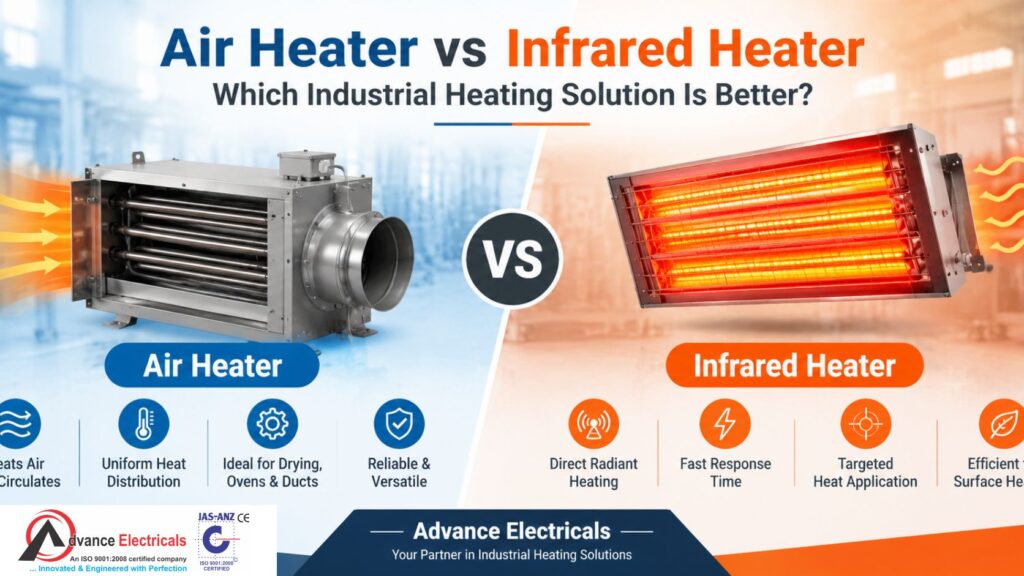
Two commonly used industrial heating solutions are air heaters and infrared heaters. Both are designed to provide heat, but they work in different ways and are suitable for different applications.
In this blog, we will compare air heaters and infrared heaters, explain their benefits and applications, and help you understand which heating solution may be better for your industrial requirements.
What Is an Air Heater?
An air heater is an electrical heating device that heats air and transfers the heat to a particular area, material, or process. It generally uses an electrical heating element to increase the temperature of the passing air.
Air heaters are widely used in industrial systems where controlled hot air is required for heating, drying, warming, or temperature maintenance.
Key Benefits of Air Heaters
- Uniform heat distribution: Heated air can be circulated throughout a designated area or system.
- Suitable for continuous heating: Air heaters can support processes that require a steady supply of hot air.
- Versatile applications: They can be used in industrial ovens, drying systems, air ducts, and process heating equipment.
- Temperature control: With suitable controllers and sensors, the required air temperature can be maintained.
- Flexible installation: Different designs are available to suit various industrial heating requirements.
Common Applications of Air Heaters
Air heaters are commonly used in:
- Industrial drying and heating systems
- Plastic processing machinery
- Packaging and manufacturing equipment
- Air ducts and ventilation systems
- Industrial ovens and hot air circulation systems
- General process heating applications
The right air heater depends on factors such as airflow, operating temperature, heater capacity, installation space, and the material being heated.
What Is an Infrared Heater?
An infrared heater transfers heat mainly through infrared radiation. Instead of heating the surrounding air first, it directs radiant energy toward a surface or material.
When the material absorbs this energy, its temperature increases. This makes infrared heaters useful for applications where direct, targeted, or rapid surface heating is required.
Infrared heaters are available in different designs, including ceramic, quartz, and other industrial infrared heating elements.
Key Benefits of Infrared Heaters
- Direct heating: Infrared energy can heat the target surface without relying entirely on hot air.
- Fast response: Some infrared systems can reach their operating temperature quickly, depending on the heater design.
- Targeted heat application: Heat can be directed toward specific products or surfaces.
- Reduced unnecessary heating: In suitable applications, infrared heating can reduce the need to heat a large volume of surrounding air.
- Useful for surface treatment: Infrared heaters are suitable for drying coatings, heating sheets, and warming product surfaces.
Common Applications of Infrared Heaters
Infrared heaters are commonly used in:
- Plastic sheet and film heating
- Paint and coating drying
- Printing and packaging industries
- Surface heating and curing processes
- Textile processing
- Food processing equipment designed for infrared heating
- Industrial ovens and manufacturing lines
The performance of an infrared heater depends on the material’s ability to absorb infrared energy, the distance from the heater, the required temperature, and the heating time.
Air Heater vs Infrared Heater: Key Differences
Air heaters and infrared heaters both provide industrial heat, but their heating methods and ideal applications are different.
| Comparison Factor | Air Heater | Infrared Heater |
| Heating method | Heats air and transfers heat through airflow | Transfers heat mainly through infrared radiation |
| Heat transfer | Primarily through moving hot air | Primarily through radiant energy |
| Best suited for | Processes requiring hot air circulation | Processes requiring direct or targeted heating |
| Heating uniformity | Depends on airflow and system design | Depends on radiation pattern, distance, and surface properties |
| Response time | Depends on heater capacity and airflow | Can be fast, depending on heater type |
| Typical applications | Drying, air heating, ovens, and ducts | Surface heating, coatings, films, and targeted drying |
| Installation | Often integrated into an air passage or circulation system | Usually positioned according to the target surface and required heating pattern |
| Energy efficiency | Depends on airflow, insulation, and process losses | Depends on absorption, target coverage, and process losses |
Neither option is automatically more efficient in every situation. The better choice depends on the material, heating method, production speed, and operating conditions.
Which Heater Is Better for Industrial Applications?
The right choice depends on what you need to heat and how the process operates.
1. Choose an Air Heater for Hot Air Applications
An air heater may be the better option when your process requires heated air to circulate through equipment or across a product.
For example, industrial drying systems may need a continuous supply of hot air to remove moisture from materials. Air heaters can also be useful in ventilation ducts, industrial ovens, and equipment that depends on controlled airflow.
If your process requires a specific air temperature and a consistent flow of heated air, an air heater is worth considering.
2. Choose an Infrared Heater for Direct Surface Heating
An infrared heater may be more suitable when you need to heat a particular surface without first heating all the surrounding air.
For example, plastic sheets may require rapid heating before forming, while coated products may need controlled surface heating during a drying process.
Infrared heating can be useful when the target material absorbs the radiation effectively and the heater can be positioned to deliver heat where it is needed.
3. Consider the Material Being Heated
The material is an important factor when selecting an industrial heater.
Some materials absorb infrared energy effectively, while others may reflect it or allow it to pass through. In such cases, infrared heating performance may vary.
Air heaters can be a suitable alternative when the process depends on heated airflow rather than direct radiation.
Before choosing a heater, consider the material’s thickness, surface properties, heat sensitivity, and required operating temperature.
4. Compare Energy Consumption
Energy efficiency depends on how effectively a heating system transfers energy to the target material.
An infrared heater may reduce energy losses when heat can be directed toward a specific surface. An air heater may perform well when a process requires hot air throughout an enclosed space or production system.
Factors such as insulation, operating time, temperature settings, airflow, and heat loss should be evaluated before making a decision.
It is always better to compare the complete heating process rather than choosing a heater based only on its rated power.
Important Factors to Consider Before Selecting an Industrial Heater
Before investing in an air heater or an infrared heater, consider the following points:
- Required temperature: Identify the temperature needed for your process.
- Heating method: Decide whether you need hot air circulation or direct surface heating.
- Material type: Check how the material responds to hot air or infrared radiation.
- Production speed: Consider how quickly the material must reach the required temperature.
- Available installation space: Make sure the heater fits the equipment and operating environment.
- Energy consumption: Evaluate power requirements and overall process efficiency.
- Temperature control: Select a suitable controller and temperature sensor where required.
- Safety requirements: Consider insulation, surface temperatures, airflow, electrical protection, and over-temperature controls.
Discussing these factors with an experienced industrial heater supplier can help you select a suitable solution for your application.
Why Choose Advance Electricals for Industrial Heating Solutions?
Advance Electricals provides industrial heating solutions for a range of manufacturing and processing requirements. Selecting the right heater involves understanding the application, operating temperature, material, and production needs.
Whether you are looking for air heaters or infrared heaters, it is important to choose a solution that matches your equipment and heating process.
Advance Electricals can help you explore suitable industrial heating options based on your application requirements. A properly selected heating solution can support reliable operation, consistent heating, and efficient production.
If you are planning to install a new heating system or upgrade existing equipment, Contact Advance Electricals to discuss your industrial heating requirements and identify a suitable solution for your process.
Conclusion
Air heaters and infrared heaters both play an important role in industrial heating, but each serves different purposes.
Air heaters are generally suitable for applications that require heated air circulation, while infrared heaters are useful when direct, targeted surface heating is needed. The best solution depends on your material, production process, temperature requirements, and operating conditions.
Before selecting a heating system, evaluate your application carefully and compare the expected performance of both options.
Frequently Asked Questions (FAQs)
1. What is the main difference between an air heater and an infrared heater?
An air heater heats air and transfers heat through airflow, while an infrared heater transfers heat mainly through radiation directly to a target surface or material
2. Which is more energy-efficient: an air heater or an infrared heater?
Neither is always more energy-efficient. Infrared heaters may be effective for targeted surface heating, while air heaters can be suitable for processes requiring hot air circulation. Actual efficiency depends on the application and heat losses
3. Are infrared heaters suitable for plastic processing?
Yes. Infrared heaters are used in applications such as heating plastic sheets and films. The correct heater depends on the type of plastic, its thickness, and the required temperature.
4. Where are industrial air heaters commonly used?
Industrial air heaters are used in drying systems, industrial ovens, air ducts, packaging equipment, and manufacturing processes that require controlled hot air.
5. How do I choose the right industrial heater for my application?
Consider the material, required temperature, heating time, airflow requirements, installation space, energy consumption, and safety requirements. Consult a qualified industrial heating supplier if you need help selecting the appropriate heater.