
Temperature measurement is an important part of many industrial processes. Accurate temperature monitoring helps industries maintain product quality, improve process efficiency, and protect heating equipment from overheating. A thermocouple is one of the most commonly used temperature sensors for industrial applications.
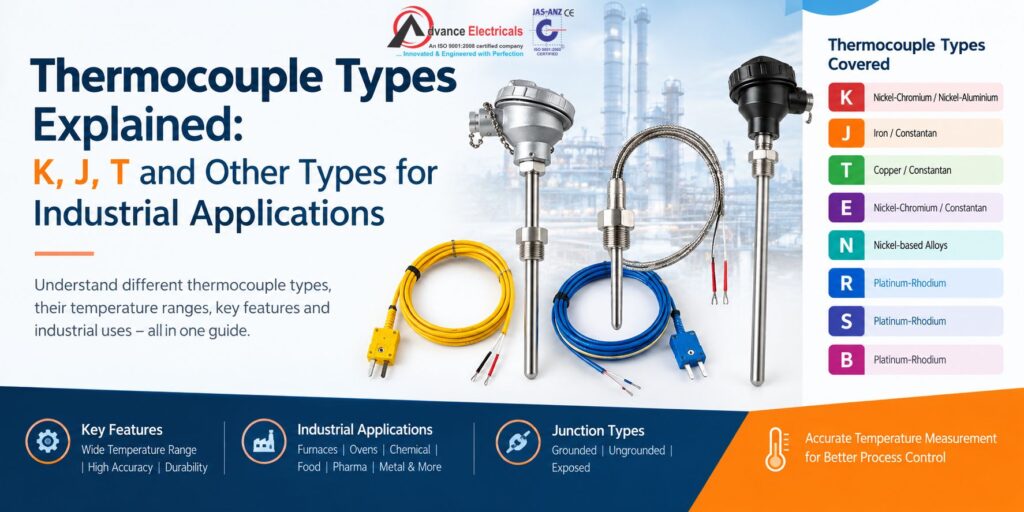
Thermocouples are available in different types, including Type K, Type J, Type T, Type E, Type N, Type R, Type S, and Type B. Each type has different temperature ranges, materials, characteristics, and applications.
Choosing the correct thermocouple type depends on factors such as operating temperature, environment, accuracy requirements, response time, and compatibility with the equipment.
In this guide, we will explain the major types of thermocouples and their industrial applications.
What Is a Thermocouple?
A thermocouple is a temperature sensor made by joining two different metal wires at one end. When the joined end is exposed to heat, it generates a small electrical voltage. This voltage changes according to the temperature.
A temperature measuring instrument or controller uses this electrical signal to determine the temperature.
The basic working principle can be explained as:
Heat → Voltage Generation → Signal Measurement → Temperature Reading
Thermocouples are popular in industrial applications because they are simple, durable, and capable of measuring a wide range of temperatures.
How Does a Thermocouple Work?
A thermocouple consists of two different metal conductors joined together at the measuring junction.
When there is a temperature difference between the measuring junction and the reference junction, a small voltage is produced. This phenomenon is known as the Seebeck effect.
The generated voltage is measured by a temperature controller or other compatible instrument, which converts the signal into a temperature reading.
Because different combinations of metals produce different electrical characteristics, thermocouples are classified into different types.
Different Types of Thermocouples
1. Type K Thermocouple
Type K is one of the most widely used thermocouple types for general industrial temperature measurement.
It is made from:
- Nickel-Chromium (NiCr)
- Nickel-Aluminium (NiAl)
Key Features
- Wide temperature measurement range
- Good resistance to oxidation
- Suitable for many industrial environments
- Commonly available
- Cost-effective for general applications
Applications
Type K thermocouples are commonly used in:
- Industrial furnaces
- Ovens
- Plastic processing machinery
- Heating systems
- Kilns
- Boilers
- Heat treatment equipment
- Industrial process monitoring
For many general-purpose industrial heating applications, Type K is a commonly selected option.
2. Type J Thermocouple
Type J thermocouples are made from:
- Iron
- Constantan
They are commonly used for moderate-temperature applications.
Key Features
- Good sensitivity
- Suitable for moderate temperatures
- Useful in industrial equipment
- Compatible with many older temperature-control systems
Applications
Type J thermocouples can be used in:
- Plastic machinery
- Industrial ovens
- Packaging machines
- Manufacturing equipment
- Heating systems
- General process monitoring
One consideration with Type J is that its iron element can oxidize more easily at higher temperatures, especially in unsuitable environments.
3. Type T Thermocouple
Type T thermocouples use:
- Copper
- Constantan
They are known for good stability and are particularly useful for relatively low-temperature measurements.
Key Features
- Good accuracy at lower temperatures
- Stable performance
- Suitable for moist environments
- Good repeatability
Applications
Type T thermocouples are often used for:
- Refrigeration systems
- Food processing
- Laboratory equipment
- Cold storage
- Environmental monitoring
- Low-temperature industrial processes
4. Type E Thermocouple
Type E consists of:
- Nickel-Chromium
- Constantan
It provides relatively high thermoelectric output compared with several other common thermocouple types.
Applications
Type E thermocouples are used in:
- Cryogenic applications
- Industrial temperature monitoring
- Laboratory equipment
- Vacuum systems
- General process measurement
They can be useful when a stronger thermoelectric signal is beneficial.
5. Type N Thermocouple
Type N thermocouples are made from specialized nickel-based alloys.
They are designed for stable performance at high temperatures and can offer improved resistance to certain forms of drift compared with Type K in demanding environments.
Applications
Type N thermocouples are used in:
- High-temperature furnaces
- Heat treatment equipment
- Kilns
- Industrial ovens
- Power generation equipment
- High-temperature process monitoring
Type N can be considered when long-term stability at elevated temperatures is an important requirement.
6. Type R Thermocouple
Type R thermocouples use platinum and rhodium-based materials.
They are designed for high-temperature applications where good stability and accuracy are required.
Applications
They are commonly used in:
- High-temperature furnaces
- Glass manufacturing
- Ceramic processing
- Heat treatment
- Laboratory furnaces
- Industrial processing
Because they use precious metals, Type R thermocouples are generally more expensive than base-metal thermocouples.
7. Type S Thermocouple
Type S thermocouples are also made using platinum and rhodium-based materials.
They are suitable for high-temperature measurement and are known for stable performance.
Applications
Type S thermocouples are commonly used in:
- Industrial furnaces
- Glass production
- Ceramic manufacturing
- High-temperature laboratories
- Heat treatment processes
They are often selected where reliable high-temperature measurement is required.
8. Type B Thermocouple
Type B thermocouples use platinum-rhodium alloy combinations and are designed for very high-temperature applications.
They offer good stability at extremely high temperatures.
Applications
Type B thermocouples can be used in:
- High-temperature furnaces
- Glass industries
- Ceramic industries
- Metal processing
- Specialized heat treatment applications
They are generally used for demanding high-temperature environments rather than ordinary temperature measurement.
Thermocouple Types Comparison
| Type | Common Materials | General Temperature Range* | Typical Applications |
| Type K | Nickel-Chromium / Nickel-Aluminium | Approximately -200°C to 1260°C | Furnaces, ovens, machinery |
| Type J | Iron / Constantan | Approximately -210°C to 760°C | Industrial machinery, ovens |
| Type T | Copper / Constantan | Approximately -200°C to 370°C | Refrigeration, food processing |
| Type E | Nickel-Chromium / Constantan | Approximately -200°C to 900°C | Cryogenic and industrial applications |
| Type N | Nickel-based alloys | Approximately -200°C to 1300°C | Furnaces, high-temperature systems |
| Type R | Platinum-Rhodium | Approximately -50°C to 1768°C | Glass, ceramics, furnaces |
| Type S | Platinum-Rhodium | Approximately -50°C to 1768°C | High-temperature industrial processes |
| Type B | Platinum-Rhodium | Approximately 0°C to 1820°C | Very high-temperature applications |
*Temperature ranges are approximate and depend on the thermocouple construction, insulation, sheath, accuracy class, and applicable standards.
Thermocouple Junction Types
Apart from the thermocouple type, the junction construction also affects performance.
Grounded Junction
In a grounded junction, the thermocouple wires are electrically connected to the protective metal sheath.
Advantages
- Faster response
- Good heat transfer
- Suitable for many industrial applications
However, electrical isolation from the process is not provided.
Ungrounded Junction
In an ungrounded junction, the thermocouple junction is electrically isolated from the metal sheath.
Advantages
- Electrical isolation
- Useful where electrical noise or grounding issues may be a concern
- Suitable for sensitive measurement systems
Exposed Junction
The thermocouple junction is directly exposed to the surrounding environment.
Advantages
- Very fast response
- Suitable for clean and non-corrosive environments
The exposed junction is more vulnerable to mechanical damage and contamination.
Common Industrial Applications of Thermocouples
Thermocouples are used across a wide range of industries.
Plastic Processing
Thermocouples help monitor temperatures in:
- Extrusion machines
- Injection moulding machines
- Dies
- Heating zones
- Plastic processing equipment
Accurate temperature monitoring helps maintain consistent processing conditions.
Industrial Ovens and Furnaces
Thermocouples are used to monitor and control temperature in:
- Industrial ovens
- Furnaces
- Kilns
- Heat treatment systems
- Drying chambers
Food Processing
Temperature monitoring is important for cooking, drying, sterilization, and other food-processing operations.
Thermocouples can be used in:
- Industrial ovens
- Food processing machines
- Heating equipment
- Refrigeration systems
Chemical Processing
Chemical processes often require precise temperature monitoring.
Thermocouples can be installed in:
- Process tanks
- Reactors
- Heating systems
- Pipelines
- Industrial vessels
The sheath and thermocouple construction should be selected according to the chemical environment.
Pharmaceutical Industry
Thermocouples can be used to monitor temperature in:
- Processing equipment
- Drying systems
- Sterilization equipment
- Storage systems
- Laboratory equipment
Metal and Heat Treatment Industry
High-temperature thermocouples are commonly used in:
- Heat treatment furnaces
- Metal processing
- Forging equipment
- Annealing systems
- Industrial furnaces
How to Choose the Right Thermocouple?
Selecting the correct thermocouple depends on the application and operating environment.
1. Determine the Temperature Range
First identify the minimum and maximum temperature that needs to be measured.
2. Consider the Environment
Check whether the thermocouple will be exposed to:
- Moisture
- Chemicals
- Oxidation
- Vibration
- Pressure
- High temperatures
3. Select the Appropriate Thermocouple Type
Choose Type K, J, T, N, R, S, B, or another suitable type according to the temperature and application.
4. Select the Sheath Material
The sheath protects the thermocouple from the surrounding environment. Common sheath materials may include stainless steel and other alloys depending on the application.
5. Choose the Junction Type
Grounded, ungrounded, and exposed junctions provide different response and electrical characteristics.
6. Consider Response Time
If the process temperature changes quickly, a faster-response thermocouple design may be required.
7. Check Compatibility
The thermocouple must be compatible with the temperature controller, indicator, PLC, or other measurement equipment being used.
Benefits of Industrial Thermocouples
Thermocouples are widely used because they offer several practical benefits:
- Wide temperature measurement capability
- Simple construction
- Fast response options
- Suitable for harsh industrial environments
- Available in different configurations
- Easy integration with temperature controllers
- Can be customized for different applications
- Suitable for many industrial processes
Thermocouple Maintenance Tips
Regular inspection can help maintain reliable temperature measurement.
Some useful maintenance practices include:
- Inspect the thermocouple for physical damage.
- Check the cable and electrical connections.
- Look for corrosion or contamination.
- Verify temperature readings periodically.
- Check the protective sheath.
- Make sure the thermocouple is correctly positioned.
- Replace damaged or unstable sensors when necessary.
Incorrect installation or a damaged thermocouple can result in inaccurate temperature readings and may affect the heating process.
Why Choose Advance Electricals for Thermocouples?
Selecting the correct temperature sensor is important for maintaining accurate process control. Advance Electricals provides thermocouple solutions for different industrial heating and temperature measurement requirements.
Based on the application, factors such as thermocouple type, temperature range, sheath material, length, diameter, junction construction, and connection arrangement can be considered when selecting a suitable thermocouple.
Conclusion
Thermocouples are essential temperature sensors for many industrial heating and manufacturing processes. Different types are designed for different temperature ranges and operating environments.
Type K is widely used for general industrial applications, while Type J is commonly used for moderate-temperature systems. Type T is useful for lower-temperature measurements, and Types N, R, S, and B can be selected for more demanding high-temperature applications.
The right thermocouple should be selected based on temperature range, environment, accuracy, response time, junction type, sheath material, and compatibility with the control system.
For reliable industrial temperature measurement, choosing the correct thermocouple design can help maintain stable process conditions and improve heating-system performance.
Get the Right Thermocouple for Your Application
Need a thermocouple for an industrial heating or temperature measurement application?
Contact Advance Electricals to discuss your temperature range, equipment type, mounting requirements, and other application details and get a suitable thermocouple solution for your
Frequently Asked Questions (FAQs)
Type K is one of the most widely used thermocouples for general industrial temperature measurement because of its broad temperature capability and versatility.
Type K uses nickel-chromium and nickel-aluminium alloys, while Type J uses iron and constantan. Type K generally provides a wider useful temperature range for industrial applications.
Type T thermocouples are commonly used for relatively low-temperature applications, including refrigeration, food processing, laboratories, and environmental monitoring.
Types N, R, S, and B can be used for high-temperature applications, depending on the exact temperature, environment, accuracy requirements, and construction.
Yes. Thermocouples can be customized in terms of length, diameter, sheath material, junction type, cable, connector, mounting arrangement, and other application-specific requirements.
Thermocouple life depends on temperature, environment, mechanical conditions, sheath material, and operating frequency. Regular inspection can help identify when replacement is required.