
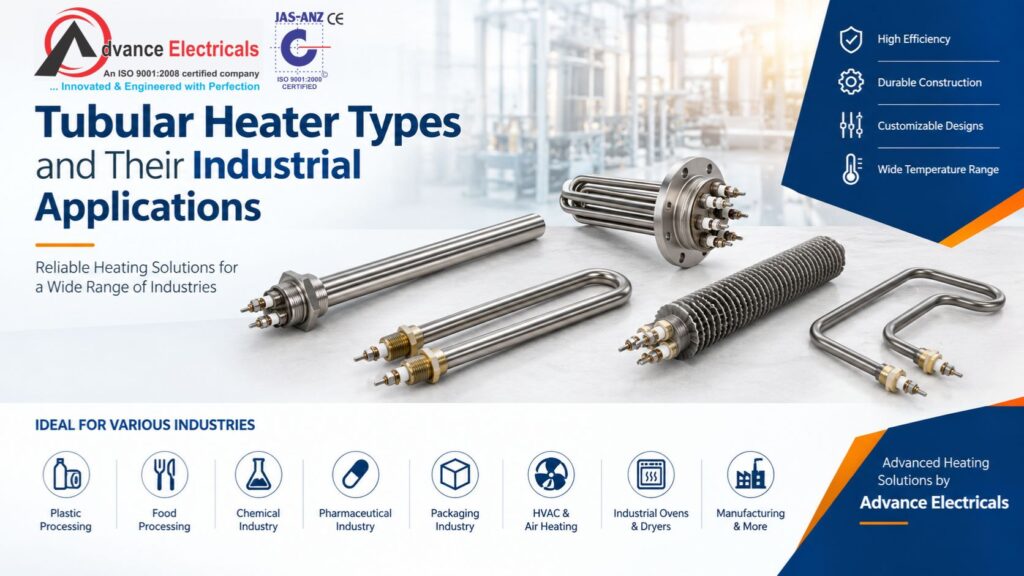
Tubular heaters are widely used in industrial and commercial heating applications where reliable, controlled, and efficient heat is required. Their strong construction, flexible design, and ability to operate in different environments make them suitable for heating air, liquids, surfaces, tanks, ovens, and industrial equipment.
Different industries have different heating requirements, which is why tubular heaters are available in several shapes, sizes, wattages, and configurations. Choosing the right type of tubular heater can improve heating performance, energy efficiency, and equipment life.
In this guide, we will explain the major tubular heater types, their working principle, applications, benefits, and factors to consider when selecting one.
What Is a Tubular Heater?
A tubular heater is an electrical heating element made using a metal tube that contains a resistance heating wire. The heating wire is electrically insulated from the outer sheath using high-quality insulating material, generally magnesium oxide (MgO).
When electricity passes through the resistance wire, electrical energy is converted into heat. The heat is then transferred through the metal sheath to the surrounding air, liquid, surface, or equipment.
Tubular heaters can be manufactured in different shapes, including straight, U-shaped, W-shaped, and custom-bent designs, depending on the application.
How Do Tubular Heaters Work?
1. The working principle of a tubular heater is simple.
2. Electrical power is supplied to the heating element.
3. Current passes through the internal resistance wire.
4. The resistance wire generates heat.
5. Magnesium oxide insulation transfers the heat toward the outer metal sheath.
6. The outer sheath transfers heat to the required medium or surface.
A thermostat, temperature controller, or sensor can be used to maintain the required temperature.
Because the heating element is protected inside a metal sheath, tubular heaters can be designed for demanding industrial environments.
Major Tubular Heater Types
Tubular heaters can be classified according to their shape, application, mounting method, and heating requirement. Some commonly used types include:
1. Straight Tubular Heaters
Straight tubular heaters have a simple linear design and are commonly used where direct and uniform heating is required.
Applications:
- Industrial ovens
- Drying equipment
- Air heaters
- Heating chambers
- Furnaces
- Industrial machines
Their simple construction also makes them suitable for customized heating assemblies.
2. U-Shaped Tubular Heaters
U-shaped heaters are bent into a U configuration to provide a larger heating area while maintaining a compact installation size.
Applications:
- Water heating equipment
- Industrial tanks
- Ovens
- Washing equipment
- Storage heaters
- Industrial heating systems
They are useful when the available installation space is limited but a higher heating area is required.
3. W-Shaped Tubular Heaters
W-shaped tubular heaters provide an extended heating surface within a relatively compact space. They are often used when greater heat distribution is required.
Applications:
- Ovens
- Air heating systems
- Drying machines
- Industrial chambers
- Heating equipment
The shape can be customized according to the equipment design and heating requirements.
4. Finned Tubular Heaters
Finned tubular heaters have metal fins attached around the outer tube. These fins increase the surface area and help transfer heat more effectively to air.
They are particularly useful for air heating applications.
Applications:
- Air handling units
- HVAC equipment
- Industrial ovens
- Air ducts
- Heating chambers
- Drying systems
- Electrical equipment
Finned designs can provide better heat transfer than plain tubular heaters when heating moving air.
5. Flanged Tubular Heaters
Flanged tubular heaters are designed with a flange that allows the heating element to be mounted securely onto tanks, vessels, or other equipment.
Applications:
- Water tanks
- Oil tanks
- Chemical processing equipment
- Industrial boilers
- Storage vessels
- Process heating systems
The flange provides a convenient mounting arrangement and can also help simplify maintenance.
6. Screw Plug Tubular Heaters
Screw plug heaters are mounted using a threaded screw plug. They are commonly used for heating liquids stored inside tanks and vessels.
Applications:
- Water heating
- Oil heating
- Chemical solutions
- Process tanks
- Industrial fluid heating
The heater size, wattage, tube material, and thread size can be selected according to the application.
7. Custom-Bent Tubular Heaters
Some industrial applications require a specific heater shape to fit around machinery or inside a particular heating chamber. In such cases, tubular heaters can be bent into customized configurations.
Applications:
- Industrial machinery
- Special-purpose ovens
- Packaging equipment
- Process heating systems
- Customized heating assemblies
Custom bending allows manufacturers to design heaters according to the available installation space and required heating pattern.
Applications of Tubular Heaters Across Industries
Tubular heaters are used across a wide range of industries because they can be customized for different heating requirements.
Plastic Processing Industry
Tubular heating elements can be used in plastic processing machinery for heating different components and processing areas.
They can be designed according to specific temperature, wattage, and dimensional requirements.
Food Processing Industry
Food processing equipment often requires controlled heating for cooking, drying, warming, and processing.
Tubular heaters are used in:
- Food warming equipment
- Ovens
- Drying systems
- Cooking equipment
- Heating tanks
- Processing machines
The appropriate sheath material and heater design should be selected based on the operating environment.
Chemical Industry
Chemical processing often involves heating liquids, tanks, and process equipment. Tubular heaters can be designed for different chemical and temperature requirements.
Common applications include:
- Chemical tanks
- Process vessels
- Oil heating
- Fluid heating
- Industrial baths
Material selection is particularly important in chemical applications because the heater may come into contact with corrosive or reactive substances.
Pharmaceutical Industry
Pharmaceutical manufacturing requires controlled and consistent process conditions. Tubular heaters can be used in equipment where indirect or direct heating is required.
Applications may include:
- Drying equipment
- Heating chambers
- Process tanks
- Industrial ovens
- Temperature-controlled systems
The heater design should match the equipment’s cleanliness, temperature, and material requirements.
Packaging Industry
Packaging machines may require heating for sealing, forming, shrinking, or other production processes.
Tubular heating elements can be customized for:
- Packaging machines
- Heat sealing equipment
- Shrink systems
- Industrial heating units
Their compact and customizable design makes them suitable for many packaging applications.
HVAC and Air Heating
Finned tubular heaters are commonly used for heating air because the fins increase the available heat transfer surface.
They can be found in:
- Air heaters
- HVAC systems
- Air ducts
- Heating units
- Ventilation equipment
- Drying chambers
Industrial Ovens and Dryers
Industrial ovens and drying systems require reliable heating over extended operating periods. Tubular heaters can be arranged inside the chamber to provide the required heat distribution.
They are used in:
- Paint curing ovens
- Industrial drying ovens
- Heat treatment equipment
- Component drying systems
- Powder coating ovens
Benefits of Tubular Heaters
Tubular heaters offer several advantages for industrial heating applications.
High Heating Efficiency
Tubular heaters convert electrical energy into heat and can be designed to provide efficient heat transfer according to the application.
Strong Construction
The metal sheath protects the internal heating wire and insulation, making tubular heaters suitable for demanding operating conditions.
Flexible Design
They are available in different diameters, lengths, shapes, wattages, and mounting configurations.
Customization
Manufacturers can customize tubular heaters according to required voltage, wattage, dimensions, sheath material, terminal configuration, and bending pattern.
Wide Temperature Range
Tubular heating elements can be designed for a broad range of industrial heating applications, depending on construction and operating conditions.
Easy Integration
Their different shapes and mounting options make tubular heaters relatively easy to integrate into machines, tanks, ovens, and heating systems.
How to Choose the Right Tubular Heater?
Selecting the correct tubular heater is important for achieving reliable heating performance. Consider the following factors:
1. Heating Medium
First determine whether the heater will heat air, water, oil, chemicals, surfaces, or another material.
2. Required Temperature
The operating temperature and maximum required temperature should be considered before selecting the heater.
3. Voltage and Wattage
Choose the correct voltage and wattage according to the electrical system and required heating capacity.
4. Heater Dimensions
The heater length, diameter, shape, and available installation space should match the equipment.
5. Sheath Material
The sheath material should be selected according to temperature, moisture, corrosion, and the medium being heated.
6. Mounting Arrangement
Consider whether the application requires a screw plug, flange, brackets, terminals, or another mounting method.
7. Operating Environment
Moisture, chemicals, airflow, vibration, and continuous operating conditions can affect heater selection and service life.
Tubular Heater Maintenance Tips
Proper maintenance can help maintain consistent heating performance and extend heater life.
- Keep the heating surface clean.
- Inspect terminals and electrical connections regularly.
- Check for signs of overheating or physical damage.
- Avoid operating the heater outside its specified conditions.
- Prevent excessive scale buildup in liquid heating applications.
- Check temperature sensors and controllers periodically.
- Ensure proper installation and electrical protection.
- Replace damaged heating elements promptly.
Regular inspection is especially important in continuous industrial operations.
Why Choose a Reliable Tubular Heater Manufacturer?
The performance of a heating element depends not only on its design but also on manufacturing quality, material selection, insulation, electrical specifications, and testing.
A reliable manufacturer can help you select the appropriate heater based on your application, operating temperature, power requirement, installation space, and heating medium.
Advance Electricals provides industrial heating solutions designed for different applications and equipment requirements. Our team can help with customized heater specifications based on your technical requirements.
Conclusion
Tubular heaters are versatile heating elements used in industries such as plastic processing, food processing, chemicals, pharmaceuticals, packaging, HVAC, and industrial manufacturing. Their availability in straight, U-shaped, W-shaped, finned, flanged, screw plug, and custom configurations makes them suitable for a wide variety of applications.
The right heater should be selected based on the heating medium, temperature, voltage, wattage, dimensions, sheath material, mounting method, and operating environment.
If you need a reliable heating solution for your industrial equipment, Advance Electricals can help you select or customize the right tubular heater according to your application requirements.
Need the Right Tubular Heater for Your Application?
Contact Advance Electricals today to discuss your heating requirements and get a suitable tubular heater solution for your industrial application.