Corrugated boxes are widely used for packaging products across industries such as e-commerce, food, pharmaceuticals, electronics, automobiles, and consumer goods. During corrugated box manufacturing, controlled and uniform heating plays an important role in maintaining production quality and consistency.
Heating systems are used at different stages of the corrugation process, particularly where adhesives need to be heated, moisture needs to be controlled, or specific temperatures must be maintained for smooth production. Traditional heating methods may sometimes result in uneven temperature distribution, higher energy consumption, and inconsistent production.
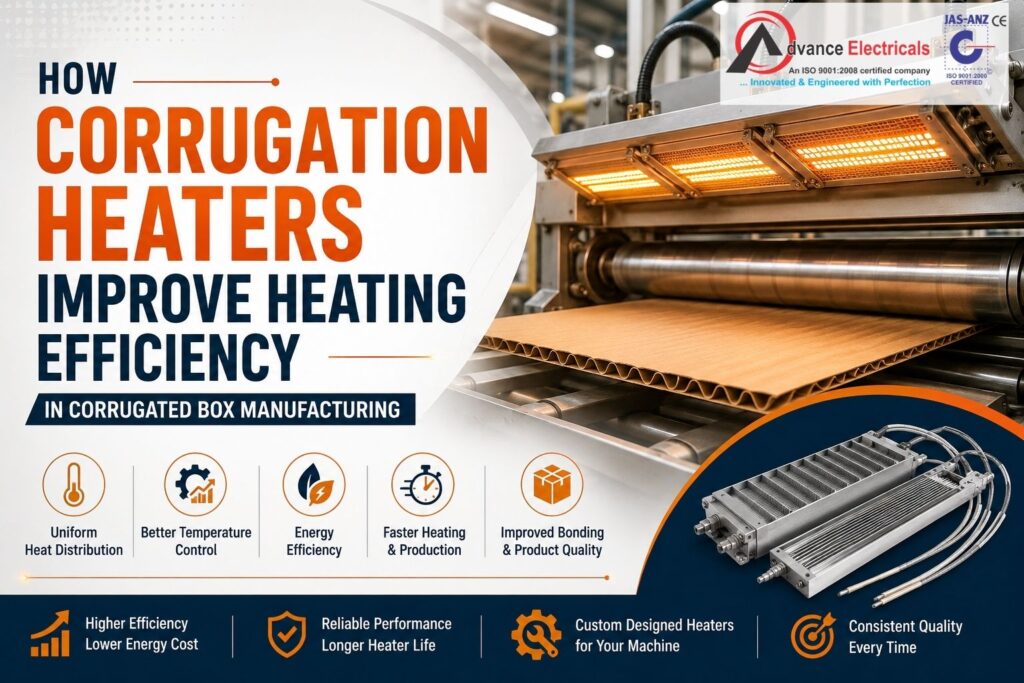
Corrugation Heaters are designed to provide controlled and efficient heating for corrugating machinery. With proper temperature control and uniform heat distribution, these heaters can help manufacturers improve production efficiency, reduce energy wastage, and maintain consistent box quality.
What Are Corrugation Heaters?
Corrugation heaters are specialized heating elements used in corrugation machines and related packaging equipment. They are designed to deliver controlled heat to specific areas of the machine where temperature plays an important role in the manufacturing process.
Depending on the machine design and application, the heater may be used for heating adhesive systems, preheating components, maintaining process temperatures, or supporting other heating requirements within the corrugation line.
These heaters are generally manufactured according to the machine’s dimensions, required wattage, voltage, operating temperature, and installation requirements.
Why Is Heating Important in Corrugated Box Manufacturing?
The corrugation process requires accurate control of temperature and moisture. Paper sheets are passed through different stages to create the fluted structure that gives corrugated boards their strength and flexibility.
Heat can influence several important factors, including:
- Adhesive performance
- Paper moisture control
- Bonding quality
- Production speed
- Board strength
- Surface finish
- Overall process stability
If the temperature is too low, adhesive bonding may not be effective. On the other hand, excessive or uneven heating can affect paper quality and increase energy consumption.
For this reason, manufacturers need heating systems that can provide stable and uniform heat.
How Corrugation Heaters Improve Heating Efficiency
1. Uniform Heat Distribution
One of the major advantages of a properly designed corrugation heater is uniform heat distribution.
Uneven heating can create hot spots and cold areas, which may affect adhesive performance and paper processing. A properly designed heating element distributes heat more consistently across the required area.
This helps maintain stable operating conditions and supports consistent production quality.
2. Better Temperature Control
Modern corrugation lines require precise temperature management. Corrugation heaters can be integrated with temperature controllers, thermostats, thermocouples, or other control systems.
This allows operators to maintain the required temperature instead of continuously operating the heater at maximum power.
Better temperature control can improve process stability and help prevent unnecessary overheating.
3. Reduced Energy Wastage
Energy efficiency is an important consideration for packaging manufacturers because corrugation machines may operate for long production hours.
A heater designed according to the application’s exact requirements can deliver the required heat more efficiently. Correct wattage, suitable insulation, proper installation, and accurate temperature control can all contribute to lower energy wastage.
Instead of using excessive heating power, manufacturers can maintain the required process temperature with better control.
4. Faster Heating
Efficient heating elements can reach the required operating temperature within a shorter period.
Faster heat-up time can reduce machine waiting periods during startup and help production lines become operational more quickly.
This becomes particularly useful in manufacturing environments where machines are frequently started, stopped, or operated in different production cycles.
5. Consistent Adhesive Performance
Adhesive application is a critical part of corrugated board production. The adhesive must perform correctly to create a strong bond between paper layers.
Temperature directly affects adhesive viscosity and bonding performance. If the adhesive system is not maintained at the required temperature, bonding may become inconsistent.
A suitable heating system helps maintain stable conditions so that the adhesive can perform more consistently.
6. Improved Production Consistency
Manufacturing consistency is essential for large-scale packaging production.
When temperature remains stable throughout the process, manufacturers can reduce variations caused by temperature fluctuations. This can help produce corrugated boards with more consistent bonding, structure, and overall quality.
Stable heating also makes the manufacturing process easier to monitor and control.
Applications of Corrugation Heaters
Corrugation heaters can be used in different heating requirements associated with corrugated packaging machinery.
Common applications include:
- Corrugation machine heating systems
- Adhesive heating systems
- Preheating applications
- Glue preparation and temperature maintenance
- Paper and board processing equipment
- Packaging machinery
- Industrial heating units
- Temperature-controlled manufacturing equipment
The exact application depends on the machine configuration and the heating requirement.
Key Benefits of Using Corrugation Heaters
Using a properly selected heating system can provide several benefits to corrugated box manufacturers.
Better Energy Efficiency
Accurate heating reduces unnecessary energy consumption and supports more efficient machine operation.
Improved Product Quality
Stable and uniform temperature can contribute to consistent bonding and board quality.
Longer Heater Service Life
A heater operated within its recommended temperature and electrical specifications can have a better service life than an improperly selected heater.
Reduced Downtime
Reliable heating elements reduce the possibility of frequent heating-related interruptions and maintenance requirements.
Better Process Control
When heaters work with temperature sensors and controllers, operators can monitor and adjust the process more effectively.
Flexible Design
Industrial heaters can be manufactured in different sizes, shapes, wattages, and configurations according to machine requirements.
Factors to Consider When Selecting Corrugation Heaters
Choosing the right heater is important for achieving efficient and reliable performance. Manufacturers should consider the following factors before purchasing a heating element.
1. Required Temperature
Determine the operating temperature required for the specific application. The heater should be capable of achieving the required temperature without unnecessary overheating.
2. Wattage
The correct wattage depends on the heating load, surface area, material, operating temperature, and heat-loss conditions.
A heater with insufficient wattage may take too long to reach the desired temperature, while excessive wattage can cause overheating and unnecessary energy consumption.
3. Voltage
The heater should be compatible with the electrical supply of the machine. Voltage specifications should always be checked before installation.
4. Heater Dimensions
The physical dimensions of the heater should match the available installation space.
Correct dimensions are important for proper contact, mounting, and heat transfer.
5. Heating Element Material
The material used in the heating element affects its durability, temperature capability, and resistance to operating conditions.
The selection should be based on the application’s temperature, environment, and required service life.
6. Temperature Control
A suitable temperature control system should be used with the heater. Thermocouples, RTDs, thermostats, or digital temperature controllers can help maintain the desired operating temperature.
7. Machine Operating Conditions
Factors such as continuous operation, production speed, ambient temperature, moisture, and machine design should also be considered when selecting a heater.
Corrugation Heaters vs. Conventional Heating Methods
Traditional heating systems may provide basic heating, but they may not always offer the level of control required by modern manufacturing processes.
| Feature | Corrugation Heaters | Conventional Heating |
| Temperature Control | Better control | May be limited |
| Heat Distribution | Designed for specific applications | Can be less uniform |
| Energy Efficiency | Can be optimized | May result in higher energy loss |
| Customization | Available according to machine requirements | Often limited |
| Installation | Application-specific | Depends on system |
| Process Consistency | High when properly selected | Can vary |
The actual performance depends on heater design, installation, temperature control, insulation, and operating conditions.
How to Increase the Efficiency of Corrugation Heating Systems
Installing a good heater is only one part of improving heating efficiency. Manufacturers should also focus on proper operation and maintenance.
Maintain Proper Temperature Settings
Avoid operating the heater at a temperature higher than required. Excessive temperature can increase energy consumption and may damage materials.
Use Proper Insulation
Heat loss from exposed surfaces can reduce overall efficiency. Suitable insulation can help retain heat and reduce unnecessary energy consumption.
Check Temperature Sensors
Faulty thermocouples or sensors can provide incorrect temperature readings. Regular inspection helps maintain accurate temperature control.
Inspect Electrical Connections
Loose or damaged electrical connections can affect heater performance and create unnecessary resistance or heating.
Clean Heating Surfaces
Dust, adhesive residue, and other contaminants can interfere with heat transfer. Regular cleaning can help maintain consistent performance.
Use the Correct Heater Rating
Always use a heater with the correct voltage, wattage, dimensions, and temperature rating for the machine.
Why Custom-Made Heating Solutions Can Be Better
Every corrugation machine may have different dimensions and heating requirements. A standard heater may not always provide the ideal fit or heat distribution.
Custom-designed heating elements can be manufactured according to specific requirements such as:
- Length and width
- Voltage
- Wattage
- Operating temperature
- Mounting arrangement
- Terminal configuration
- Material
- Heating area
A properly engineered heater can provide better compatibility with the machine and help achieve more controlled heating.
Role of Temperature Controllers
Temperature controllers are an important part of an efficient heating system.
The controller receives information from a temperature sensor and regulates power supplied to the heating element. This helps maintain the desired temperature instead of allowing continuous uncontrolled heating.
A properly configured controller can help:
- Maintain stable temperature
- Reduce overheating
- Minimize energy wastage
- Improve process consistency
- Protect heating elements
- Improve product quality
For industrial corrugation machines, the heater and temperature control system should ideally be selected as part of the same overall heating solution.
Common Problems Caused by Poor Heating
Incorrect heating systems can create several production problems, including:
- Uneven adhesive bonding
- Inconsistent board quality
- Excessive energy consumption
- Slow machine startup
- Overheating
- Heater failure
- Frequent maintenance
- Production downtime
Many of these problems can be reduced through proper heater selection, installation, temperature control, and preventive maintenance.
Maintenance Tips for Corrugation Heating Systems
Regular maintenance can improve reliability and help extend heater service life.
Manufacturers should regularly:
- Check heater electrical connections.
- Inspect heating elements for physical damage.
- Verify temperature sensor readings.
- Check for overheating or unusual hot spots.
- Clean adhesive or material buildup.
- Inspect insulation around the heating area.
- Check temperature controller settings.
- Replace damaged heaters promptly.
Preventive maintenance is generally more effective than waiting for a heater failure to stop production.
How to Choose a Corrugation Heater Manufacturer
When selecting a heating solution provider, manufacturers should look beyond price alone.
Consider the supplier’s ability to provide:
- Application-specific heater designs
- Correct wattage and voltage
- Suitable heating materials
- Accurate dimensions
- Temperature control compatibility
- Consistent manufacturing quality
- Technical support
- Replacement support
- Reliable delivery
A manufacturer with experience in industrial heating applications can better understand the operating requirements and recommend an appropriate solution.
Conclusion
Heating efficiency has an important role in maintaining productivity and quality in corrugated box manufacturing. Stable temperature, uniform heat distribution, faster heat-up, and accurate control can all contribute to a more efficient manufacturing process.
Corrugation Heaters provide a practical heating solution for corrugation machines and related packaging applications. When the heater is correctly selected according to wattage, voltage, dimensions, temperature, and machine requirements, it can help improve process consistency while reducing unnecessary energy loss.
For manufacturers, the best results come from combining a properly designed heating element with accurate temperature control, good insulation, regular maintenance, and correct operating practices.
If you are looking for an industrial heating solution designed according to your corrugation machine requirements, Advance Electricals can help you select the appropriate heating configuration for your application.
Frequently Asked Questions (FAQs)
Corrugation heaters are used in corrugation machinery and related packaging equipment for applications requiring controlled and consistent heating.
They can improve efficiency by providing controlled and uniform heating, reducing unnecessary heat loss, supporting faster heat-up, and working with temperature control systems.
Yes. Industrial heating elements can be customized according to required dimensions, voltage, wattage, temperature, mounting arrangement, and other machine specifications.
Correct heater selection, proper temperature control, suitable insulation, regular cleaning, electrical inspection, and preventive maintenance can help improve heater service life.
Temperature control helps maintain stable processing conditions, which can support consistent adhesive performance, bonding quality, production efficiency, and overall board quality.