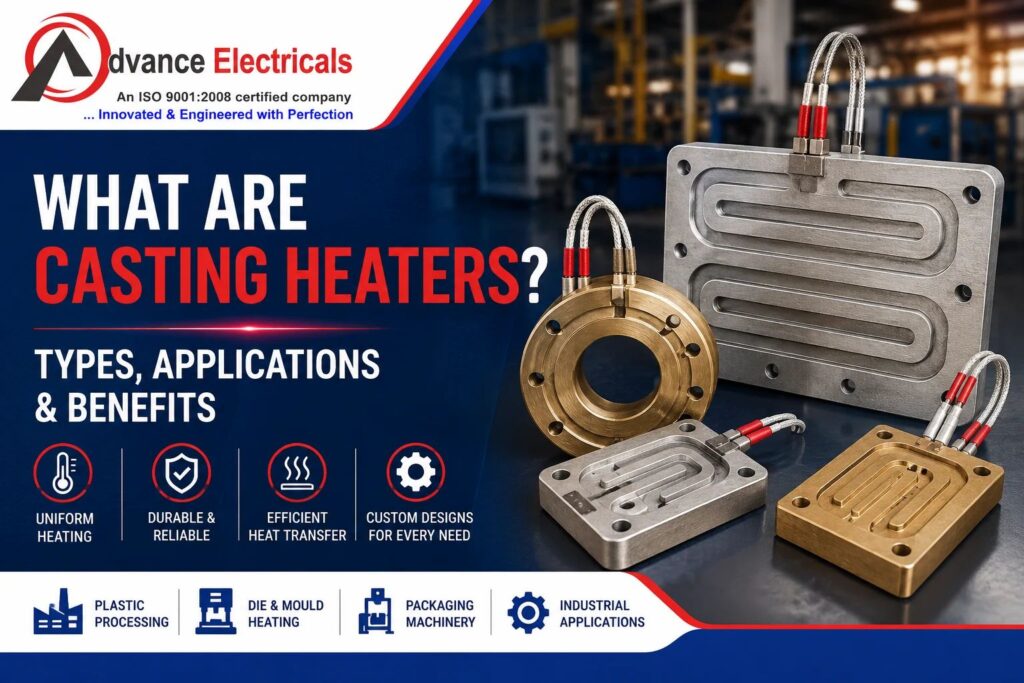
Casting heaters are widely used in industrial heating applications where uniform, reliable, and controlled heating is required. They are designed to transfer heat efficiently to moulds, dies, plates, tanks, processing equipment, and other industrial components.
Unlike simple surface heaters, casting heaters are manufactured by embedding a heating element into a cast metal body. This construction provides strong mechanical support, good heat transfer, and a durable heating solution for demanding industrial environments.
Casting heaters are commonly used in plastic processing, extrusion machines, injection molding equipment, die heating, hot plates, packaging machinery, food processing equipment, and various industrial heating systems.
In this blog, we will explain what casting heaters are, how they work, their types, applications, benefits, construction, selection factors, and maintenance requirements.
What Is a Casting Heater?
A casting heater is an industrial electric heater in which a resistance heating element is embedded or cast into a metal body such as aluminum, brass, or another suitable alloy.
When electrical power is supplied, the internal resistance element generates heat. The cast metal body then distributes and transfers the heat to the surface or component that needs to be heated.
Simple Definition
A casting heater is a custom-built industrial heating element in which a resistance heater is embedded inside a metal casting to provide uniform and controlled heat to a specific component. The casting acts as both a protective body and a heat-transfer medium.
How Does a Casting Heater Work?
Casting heaters work on the principle of electrical resistance heating. When electricity passes through the resistance wire, electrical energy is converted into heat. This heat is transferred through the cast metal body to the equipment or surface being heated.
The basic process can be represented as:
Electrical Energy → Resistance Element → Heat Generation → Metal Casting → Heated Component
Step-by-Step Working Principle
1. Electrical Power Is Supplied
The casting heater is connected to an appropriate electrical power supply according to its rated voltage and wattage.
2. Resistance Element Generates Heat
The internal resistance element produces heat when current passes through it.
3. Heat Is Transferred to the Casting
The generated heat moves from the resistance element into the surrounding cast metal.
4. Heat Is Distributed
The metal body spreads the heat over the designed heating area.
5. Heat Reaches the Application
The heat is transferred from the casting heater to the mould, die, plate, machine component, tank, or other surface.
6. Temperature Is Controlled
A thermocouple, RTD, or other temperature sensor can be used with a suitable temperature controller to maintain the required operating temperature.
Construction of a Casting Heater
The construction of a casting heater can vary depending on the application, but most designs contain several important components.
1. Resistance Heating Element
The resistance element is responsible for generating heat.
High-temperature resistance alloys are commonly selected according to the required operating temperature and heater design.
2. Metal Casting
The heating element is embedded into a metal body.
Common materials include:
- Aluminium
- Brass
- Bronze
- Other suitable heat-transfer alloys
Aluminium is often preferred when lightweight construction and efficient heat distribution are important.
3. Electrical Insulation
Electrical insulation separates the heating element from the conductive casting body.
The insulation must be capable of withstanding the required operating temperature and electrical conditions.
4. Thermocouple or Temperature Sensor
A thermocouple can be incorporated into the casting heater to measure temperature.
This allows the heater to work with a temperature controller for more accurate process control.
5. Electrical Leads
High-temperature wires or terminals connect the heating element to the power supply.
The lead configuration can be customized according to the equipment and installation requirements.
Types of Casting Heaters
Casting heaters can be classified according to their construction, material, shape, and application.
1. Aluminium Casting Heaters
Aluminium casting heaters are commonly used where good heat distribution, lightweight construction, and efficient thermal performance are required.
They are suitable for heating plates, dies, moulds, processing equipment, and various industrial surfaces.
Advantages
- Good heat distribution
- Lightweight
- Good thermal conductivity
- Suitable for customized shapes
- Relatively fast heat response
2. Brass Casting Heaters
Brass casting heaters are used where higher mechanical strength and efficient heat transfer are required.
They can be designed for applications involving nozzles, manifolds, dies, and other industrial components.
Advantages
- Good thermal conductivity
- Strong construction
- Durable
- Suitable for localized heating
- Can be customized according to component geometry
3. Plate Casting Heaters
Plate casting heaters are designed in flat or rectangular configurations.
They are used where a large surface needs to be heated uniformly.
Typical applications include:
- Heating plates
- Mould plates
- Sealing equipment
- Packaging machinery
- Industrial hot plates
4. Ring Casting Heaters
Ring-shaped casting heaters are designed to heat cylindrical components.
They can be manufactured with an internal opening that fits around the component being heated.
Typical applications include:
- Dies
- Cylinders
- Nozzles
- Pipes
- Industrial processing equipment
5. Custom-Shaped Casting Heaters
Many industrial applications require a heater that matches a specific machine component.
Custom casting heaters can be manufactured according to:
- Length
- Width
- Diameter
- Thickness
- Heating zones
- Mounting holes
- Voltage
- Wattage
- Thermocouple location
- Component shape
This makes casting heaters suitable for specialized industrial heating requirements.
Applications of Casting Heaters
Casting heaters are used across several manufacturing and processing industries.
1. Plastic Injection Molding
Injection molding machines require accurate temperature control to process plastic materials efficiently.
Casting heaters can be used for moulds, plates, dies, and other machine components where controlled heating is required.
2. Plastic Extrusion
Extrusion processes require heat in different processing zones.
Casting heaters can be used for dies and other components where uniform heat distribution is important.
3. Die Heating
Industrial dies often require controlled heating to maintain a consistent processing temperature.
Casting heaters can be designed according to the shape and dimensions of the die.
4. Mould Heating
Mould heating is an important application of casting heaters.
A properly designed heater can provide uniform heat across the mould surface, helping maintain consistent processing conditions.
5. Packaging Machines
Packaging equipment may require heat for:
- Sealing
- Forming
- Cutting
- Laminating
- Bonding
Casting heaters can be integrated into packaging machinery where a controlled heated surface is required.
6. Food Processing Equipment
Some food processing machines require controlled heating of plates, tanks, or other components.
The heater design must be selected according to the temperature, hygiene, material-contact, and equipment requirements.
7. Chemical Processing Equipment
Casting heaters can be used to maintain the temperature of certain process equipment where localized or surface heating is needed.
The heater material and design should be selected according to the process environment.
8. Industrial Hot Plates
Casting heaters can be embedded into industrial plates to provide uniform heating across the required surface.
9. Rubber Processing
Rubber processing equipment may require heating of moulds, dies, and other components.
Casting heaters can provide the controlled heating needed for these processes.
Benefits of Casting Heaters
Casting heaters offer several advantages compared with conventional heating methods.
1. Uniform Heat Distribution
One of the major benefits of a casting heater is its ability to distribute heat across a designed surface.
Uniform heating can help reduce cold spots and unwanted temperature variations.
2. Efficient Heat Transfer
Because the heating element is embedded within the metal casting, heat can be transferred efficiently through the body to the target component.
3. Strong Mechanical Construction
The casting protects the heating element and provides a rigid structure.
This makes casting heaters suitable for many industrial environments where mechanical durability is important.
4. Customizable Design
Casting heaters can be manufactured according to the exact dimensions and geometry of the application.
This is particularly useful when standard heaters cannot provide the required fit.
5. Compact Installation
The heater can be designed as part of the component or around the component, helping save installation space.
6. Better Temperature Control
Casting heaters can be combined with thermocouples or other temperature sensors to achieve controlled heating.
7. Reduced Heat Loss
When the heater is designed correctly and installed with suitable insulation, unnecessary heat loss can be reduced.
8. Suitable for Large Heating Surfaces
Casting heaters can be manufactured in larger plates and custom shapes, making them suitable for applications requiring heating over a broad surface.
9. Long Service Life
A properly designed and correctly operated casting heater can provide reliable service for industrial applications.
Actual service life depends on operating temperature, watt density, installation, thermal cycling, electrical conditions, and application environment.
Casting Heater vs. Conventional Heater
Choosing between a casting heater and another type of industrial heater depends on the application.
| Feature | Casting Heater | Conventional Surface Heater |
| Construction | Heating element embedded in metal | Heating element exposed or separately mounted |
| Heat distribution | Generally uniform across designed casting | Depends on heater design |
| Mechanical strength | High | Depends on construction |
| Custom shapes | Excellent | Limited in some designs |
| Large surface heating | Suitable | Depends on heater type |
| Temperature control | Thermocouple option available | Usually available |
| Industrial applications | Wide range | Application dependent |
| Installation | Custom/application specific | Often simpler |
Casting heaters are especially useful when the heater needs to become an integrated part of a machine component or when uniform heating across a custom surface is required.
How to Choose the Right Casting Heater?
Selecting the correct casting heater is important for heating efficiency, temperature stability, and service life.
Consider the following factors before ordering.
1. Required Operating Temperature
Determine the actual process temperature.
The heater should be selected based on the required operating temperature rather than simply choosing the heater with the highest possible temperature rating.
2. Voltage
Select a heater that matches the available electrical supply.
Incorrect voltage can result in poor performance or heater failure.
3. Wattage
Wattage determines the amount of heat the heater can produce.
The required wattage depends on:
- Component size
- Material being heated
- Target temperature
- Heating time
- Heat losses
- Ambient temperature
- Insulation
- Production requirements
4. Heating Surface
Measure the complete area that needs to be heated.
The casting heater should be designed to cover the required heating zone effectively.
5. Casting Material
Select the appropriate casting material according to:
- Required temperature
- Heat-transfer requirements
- Mechanical strength
- Weight limitations
- Operating environment
6. Heater Thickness
The thickness of the casting affects heat distribution, mechanical strength, and thermal response.
7. Thermocouple Location
If temperature control is important, the thermocouple location should be selected carefully.
A poorly positioned sensor may not accurately represent the temperature of the actual process zone.
8. Mounting Arrangement
Consider mounting holes, bolts, clamps, slots, and other installation requirements during the heater design stage.
9. Heating Zones
Some industrial applications require multiple heating zones.
A custom casting heater can be designed with separate heating zones to provide better temperature control across different sections.
Common Problems With Casting Heaters
Even a high-quality casting heater can fail if it is incorrectly selected, installed, or operated.
Uneven Heating
Possible causes include:
- Incorrect watt distribution
- Poor contact
- Incorrect heater design
- Damaged heating element
- Poor temperature control
Slow Heating
Slow heating may occur because of:
- Insufficient wattage
- Excessive heat loss
- Poor insulation
- Incorrect heater sizing
- Incorrect temperature sensor location
Heater Burnout
Burnout can be caused by:
- Excessive operating temperature
- Incorrect voltage
- Localized overheating
- Poor electrical connections
- Incorrect installation
Short Service Life
Improper mounting, thermal stress, moisture, excessive cycling, and operation outside the design specifications can reduce heater life.
How to Maintain Casting Heaters?
Proper maintenance can help improve reliability and reduce unexpected production downtime.
1. Check Electrical Connections
Inspect terminals, wires, and connections regularly.
2. Monitor Temperature
Check whether the heater is reaching and maintaining the required temperature.
3. Inspect for Physical Damage
Look for cracks, deformation, loose components, or signs of overheating.
4. Check the Thermocouple
A faulty temperature sensor can cause incorrect heating and potentially damage the heater.
5. Maintain Proper Installation
Make sure the heater is securely mounted and has the required contact with the heated component.
6. Avoid Excessive Temperature
Operating a heater continuously beyond its designed conditions can reduce service life.
7. Use Appropriate Insulation
Suitable insulation can reduce heat loss and improve energy efficiency.=
Casting Heaters for Industrial Heating Applications
Modern manufacturing processes require heating systems that can provide consistent temperature, reliable operation, and efficient heat transfer.
Casting heaters are particularly useful because their design can be customized according to the shape and heating requirements of the equipment.
For example, a casting heater for a flat mould plate may require a completely different design from a ring-shaped heater used around a cylindrical component.
This flexibility makes casting heaters suitable for many industries, including:
- Plastic processing
- Injection molding
- Extrusion
- Packaging
- Rubber processing
- Die casting
- Food processing
- Chemical processing
- General manufacturing
Casting Heater vs. Cartridge Heater
Casting heaters and cartridge heaters are both used for industrial heating, but their installation methods are different.
Casting Heater
A casting heater is generally integrated into a metal body and is designed to heat a specific surface or component.
Cartridge Heater
A cartridge heater is a cylindrical heating element that is normally inserted into a drilled hole in a block, plate, mould, or machine component.
Which One Should You Choose?
Choose a casting heater when:
- Large or custom surfaces need uniform heating
- The heater needs to be integrated into a component
- Custom shapes are required
- Mechanical protection is important
Choose a cartridge heater when:
- A drilled hole is available
- Point or localized heating is required
- Easy replacement is important
- A compact cylindrical heater is suitable
The correct choice depends on the equipment design and heating requirements.
Why Custom Casting Heaters Are Important
Standard heaters may not always provide the correct heating pattern for specialized industrial equipment.
A custom casting heater can be designed around the exact requirements of the application.
For example, the manufacturer can consider:
- Component dimensions
- Heating area
- Required temperature
- Watt density
- Heating zones
- Thermocouple position
- Mounting arrangement
- Electrical connection
- Operating environment
This allows the heater to provide a more suitable heating profile for the application.
Casting Heaters: Key Benefits at a Glance
| Benefit | Why It Matters |
| Uniform heating | Helps maintain consistent process temperature |
| Efficient heat transfer | Transfers heat effectively to the target component |
| Custom design | Fits specialized equipment |
| Strong construction | Protects the heating element |
| Compact installation | Saves space in suitable applications |
| Temperature control | Can integrate temperature sensors |
| Large-area heating | Suitable for plates and moulds |
| Reliable operation | Designed for industrial environments |
Conclusion
Casting heaters are versatile industrial heating solutions designed to provide reliable, uniform, and controlled heat to moulds, dies, plates, machine components, and other industrial equipment.
Their biggest advantages include efficient heat transfer, uniform temperature distribution, strong construction, compact installation, and customizable designs.
They are particularly useful in plastic processing, injection molding, extrusion, packaging, mould heating, die heating, rubber processing, and other industrial applications.
Choosing the right casting heater requires careful consideration of temperature, wattage, voltage, heating surface, casting material, dimensions, heating zones, thermocouple position, and installation requirements.
For specialized applications, a custom-designed heater can provide better compatibility with the equipment and help achieve the required heating profile.
If you need a casting heater designed according to your machine or component specifications, Advance Electricals can help with customized industrial heating solutions based on your required dimensions, voltage, wattage, temperature, and application.
Frequently Asked Questions (FAQs)
A casting heater is an industrial electric heater in which a resistance heating element is embedded inside a metal casting. It is designed to provide controlled and uniform heating to a specific component or surface.
Casting heaters are used in injection molding, extrusion, die and mould heating, packaging machinery, rubber processing, industrial hot plates, and various manufacturing applications.
Aluminium and brass are commonly used for casting heater bodies, depending on the required heat-transfer characteristics, temperature, mechanical strength, and application.
It works through electrical resistance heating. Electrical current passes through the resistance element, generating heat that is transferred through the metal casting to the component being heated.
Yes. Casting heaters can be customized according to dimensions, shape, wattage, voltage, heating zones, mounting holes, thermocouple position, and other application requirements.
Yes. They can be designed for moulds and plates where uniform and controlled heating is required.
Yes. A thermocouple or other temperature sensor can be incorporated into the heater design to monitor and control temperature.
Aluminium casting heaters can provide good heat distribution while keeping the heater relatively lightweight. They are commonly considered for plates, moulds, dies, and other applications requiring efficient heat transfer.
Service life varies according to operating temperature, watt density, electrical conditions, thermal cycling, installation, and maintenance. Correct sizing and operation can help extend heater life.
Consider the required temperature, voltage, wattage, heating area, casting material, dimensions, mounting method, thermocouple position, heating zones, and operating environment before selecting a heater.