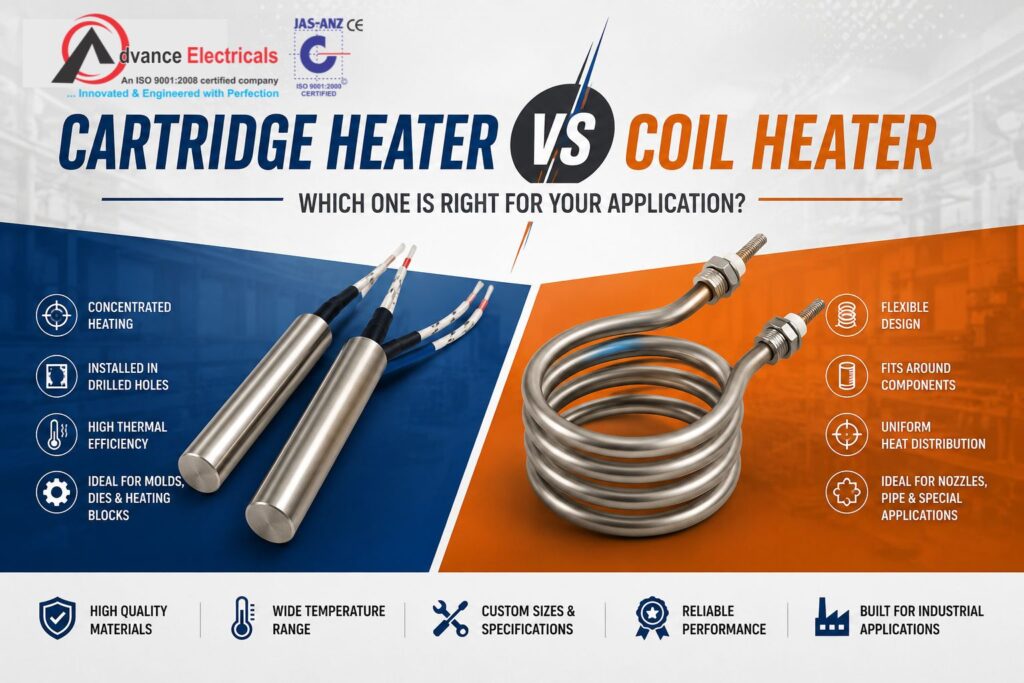
Industrial heating systems require the right heater to maintain accurate temperature, improve production efficiency, and reduce unnecessary energy consumption. Among the most commonly used options are cartridge heaters and coil heaters. Both are designed for industrial heating applications, but their construction, heating method, installation, and ideal applications are different.
Choosing between a cartridge heater and a coil heater depends on factors such as operating temperature, available space, heating area, watt density, installation method, and the type of machine or process.
In this blog, we will explain the key differences between cartridge heaters and coil heaters and help you understand which option is more suitable for your application.
What Is a Cartridge Heater?
A cartridge heater is a cylindrical electric heating element designed to provide concentrated heat in a specific area. It generally consists of a resistance heating wire placed inside a metal sheath and insulated with high-temperature electrical insulation.
Cartridge heaters are commonly installed inside drilled holes or specially designed heating blocks. Their compact construction allows them to deliver high heat output from a relatively small surface area.
High-density cartridge heaters are particularly useful when a high amount of heat is required in a limited space.
Common Applications of Cartridge Heaters
Cartridge heaters are widely used in:
- Plastic injection molding machines
- Dies and molds
- Hot runner systems
- Packaging machinery
- Sealing equipment
- Heat treatment equipment
- Industrial heating blocks
- Food processing equipment
- Printing machinery
- Laboratory and testing equipment
For applications where concentrated heating is required, cartridge heaters can provide fast and efficient heat transfer.
What Is a Coil Heater?
A coil heater is a resistance heating element manufactured in a coiled or spiral shape. The heating coil can be designed in different diameters, lengths, wattages, and configurations according to the application.
Coil heaters are especially useful when the heater needs to follow a particular shape or provide heating around a component. Depending on the design, coil heaters can also be manufactured with different terminal arrangements and can be used in compact heating zones.
Brass coil heaters are another commonly used option for applications where efficient heat transfer and close contact with the heated component are required.
Common Applications of Coil Heaters
Coil heaters are commonly used in:
- Injection molding machines
- Nozzle heating
- Plastic processing equipment
- Hot runner systems
- Extrusion machinery
- Die heating
- Packaging equipment
- Industrial heating assemblies
- Specialized heating applications
Their flexible design makes coil heaters suitable for applications where conventional cylindrical heaters may not provide the required heating configuration.
Cartridge Heater vs Coil Heater: Key Differences
Although both heaters work on the electrical resistance heating principle, they differ significantly in design and application.
| Feature | Cartridge Heater | Coil Heater |
| Basic Design | Cylindrical heating element | Coiled/spiral heating element |
| Installation | Usually inserted into a drilled hole | Wrapped, fitted, or installed around a component |
| Heating Pattern | Concentrated heating | Flexible and localized heating |
| Space Requirement | Compact | Suitable for shaped or restricted areas |
| Heat Transfer | Mainly through direct contact with the mounting block or component | Through close contact or surrounding configuration |
| Typical Use | Molds, dies, heating blocks | Nozzles, plastic machinery, dies |
| Customization | Diameter, length, wattage and voltage | Coil diameter, length, wattage and configuration |
| Best For | High-density localized heating | Flexible and shaped heating requirements |
1. Construction and Design
The biggest difference between the two heaters is their physical construction.
A cartridge heater has a straight cylindrical body. It is normally inserted into a precisely sized hole in a mold, die, plate, or heating block.
A coil heater, on the other hand, is manufactured in a spiral shape. This allows the heater to be designed around cylindrical or specially shaped components.
Therefore, the physical shape of the equipment should be considered before selecting the heater.
2. Installation Method
Cartridge heaters generally require a properly machined hole for installation. The fit between the heater and the hole is important because good contact helps improve heat transfer.
Coil heaters provide more flexibility when the heating element needs to be positioned around a nozzle, die, or other component.
If your application has a drilled heating block, a cartridge heater may be the more practical option. If the heater needs to follow a curved or cylindrical component, a coil heater may be more suitable.
3. Heat Distribution
Cartridge heaters are designed for concentrated heating. They are therefore useful when heat needs to be transferred directly into a specific block, mold, or component.
Coil heaters can provide heating around the outside of a component. Their coil configuration can be customized to match the required heating zone.
The required heat distribution should therefore be evaluated before selecting either heater.
4. Temperature Requirements
Both cartridge and coil heaters can be manufactured for high-temperature industrial applications. However, the appropriate heater depends on the required operating temperature, watt density, material, insulation, and application conditions.
Instead of choosing a heater only by its maximum temperature rating, manufacturers should consider the complete operating environment.
Important factors include:
- Required operating temperature
- Maximum temperature
- Heating time
- Watt density
- Heat loss
- Available surface area
- Material being heated
- Temperature control method
5. Watt Density
Watt density refers to the amount of electrical power applied over the heater’s surface area.
It is an important factor in both cartridge and coil heater selection.
A higher watt density can provide faster heating, but excessive watt density can create overheating, shorter heater life, or damage to the surrounding material.
For cartridge heaters, watt density is particularly important because the heater can generate a large amount of heat from a compact surface.
Coil heaters also require appropriate watt density based on their size, operating temperature, and application.
6. Heating Speed
The heating speed depends on several factors rather than the heater type alone.
These include:
- Heater wattage
- Heater size
- Material being heated
- Contact between heater and component
- Insulation
- Temperature difference
- Heat loss
- Controller accuracy
A properly selected cartridge heater can provide rapid heat-up in a compact heating zone. Coil heaters can also provide fast heating when correctly designed for the application.
Therefore, the heater should be selected based on the complete thermal requirement instead of heating speed alone.
7. Customization
Industrial heating applications often have different space and temperature requirements. Standard heaters may not always provide the required performance.
Cartridge heaters can be customized according to:
- Diameter
- Length
- Voltage
- Wattage
- Lead configuration
- Sheath material
- Terminal design
Coil heaters can also be customized according to:
- Coil diameter
- Coil length
- Heating zone
- Wattage
- Voltage
- Terminal configuration
- Shape and installation requirements
For specialized machinery, discussing the application requirements with an experienced heater manufacturer can help determine the appropriate design.
Cartridge Heater Applications
Cartridge heaters are generally a good choice when the application requires concentrated heat inside a solid component.
They are commonly used for:
Plastic Injection Molding
Cartridge heaters can be installed inside molds, dies, manifolds, and other components to provide controlled heating.
Molds and Dies
They can provide localized heat to maintain the required temperature during manufacturing processes.
Heating Blocks
Cartridge heaters are frequently installed inside aluminum, brass, or steel heating blocks.
Hot Runner Systems
High-density cartridge heaters can be used in heating components where compact design and high heat output are required.
Packaging Machinery
They can be used in sealing and forming applications where localized heating is necessary.
Coil Heater Applications
Coil heaters are particularly useful when the heating element needs to surround or closely follow a component.
Plastic Processing
Coil heaters can be used in plastic processing machinery for localized heating.
Nozzle Heating
A coil-shaped heater can be designed around a nozzle to provide heating in a compact area.
Dies and Tooling
Coil heaters can be customized for specific tooling and heating requirements.
Hot Runner Systems
Depending on the design, coil heaters can be used in hot runner and plastic processing applications.
Specialized Heating Equipment
Their customizable shape makes them useful for equipment where a standard straight heating element may not fit properly.
Advantages of Cartridge Heaters
Cartridge heaters offer several advantages:
- Compact cylindrical construction
- High heat output in a small area
- Suitable for drilled-hole installation
- Available in different diameters and lengths
- Suitable for localized heating
- Can be manufactured with different voltage and wattage options
- Useful for molds, dies, and heating blocks
- Suitable for automated industrial equipment
Advantages of Coil Heaters
Coil heaters also provide several benefits:
- Flexible coil configuration
- Suitable for compact heating areas
- Can be designed around components
- Available in customized dimensions
- Useful for nozzle and plastic processing applications
- Can provide localized heating
- Suitable for specialized machinery
How to Choose Between a Cartridge Heater and a Coil Heater?
The right heater depends on your application’s exact requirements.
Choose a Cartridge Heater When:
- You have a drilled hole available for heater installation.
- You need concentrated heat inside a metal block or component.
- High watt density is required.
- Space is limited.
- You need a compact cylindrical heating element.
- The application involves molds, dies, or heating blocks.
Choose a Coil Heater When:
- The heater needs to surround a cylindrical component.
- You need a customized heating shape.
- The application involves nozzle or plastic processing equipment.
- A flexible heating configuration is required.
- Heating needs to be provided around a specific component.
Important Factors to Consider Before Ordering
Before purchasing an industrial heater, provide the manufacturer with accurate application information.
Important specifications include:
- Voltage – The operating voltage required by the machine.
- Wattage – The amount of electrical power required.
- Heater Dimensions – Diameter, length, coil size, or heating zone.
- Operating Temperature – Normal working temperature of the process.
- Maximum Temperature – Maximum temperature required during operation.
- Installation Method – How and where the heater will be installed.
- Material Being Heated – Metal, plastic, air, liquid, or another material.
- Available Space – Physical dimensions of the heating area.
- Temperature Control – Type of controller and sensor used.
- Application Environment – Moisture, chemicals, vibration, pressure, or other conditions.
Providing these details can help the manufacturer design or recommend a heater that matches the application.
Cartridge Heater vs Coil Heater: Which One Is Better?
There is no universal answer to which heater is better.
A cartridge heater is generally more suitable for concentrated heating inside molds, dies, heating blocks, and other solid components.
A coil heater may be a better option when heating is required around a nozzle, cylindrical component, or specially shaped area.
The best choice depends on the heating requirement, available installation space, temperature, watt density, heat transfer conditions, and machine design.
In industrial heating, selecting the correct heater specification is more important than simply choosing one heater type over another.
Conclusion
Cartridge heaters and coil heaters both have an important role in modern industrial heating systems. Cartridge heaters are ideal for compact, high-density, localized heating, while coil heaters provide greater flexibility for applications that require heating around a component or within a restricted space.
Before selecting a heater, consider the operating temperature, wattage, dimensions, watt density, installation method, material being heated, and required heating pattern.
If you are unsure which heater is suitable for your application, Advance Electricals can help you evaluate your heating requirements and select a suitable industrial heating solution.
Frequently Asked Questions (FAQs)
A cartridge heater is a cylindrical heating element usually installed inside a drilled hole, while a coil heater has a spiral design and is often fitted around nozzles, dies, or other components.
Neither is universally better. Cartridge heaters are ideal for concentrated heating inside molds, dies, and heating blocks, while coil heaters are better suited for applications requiring flexible or surrounding heating.
Cartridge heaters are commonly used in plastic injection molding machines, molds, dies, hot runner systems, heating blocks, packaging machinery, and other industrial heating applications.
Coil heaters are widely used in plastic processing machinery, injection molding equipment, nozzles, dies, hot runner systems, and applications where heating is required around a specific component.
Consider the required voltage, wattage, operating temperature, heater dimensions, watt density, installation space, material being heated, and required heating pattern. An experienced heater manufacturer can help select the appropriate specification.