Industrial heating is an important part of many manufacturing and processing operations. From plastic injection molding and extrusion to chemical processing, water heating, packaging, and metal treatment, industries need controlled and reliable heat to maintain product quality and production efficiency.
Industrial heaters are designed to generate and transfer heat according to the specific requirements of an industrial process. Different applications require different heater designs, temperatures, wattages, materials, and control methods.
Choosing the right industrial heating equipment is therefore important for achieving uniform heating, maintaining accurate temperatures, reducing energy losses, and improving equipment performance.
In this blog, we will explain what industrial heaters are, how they work, the major types of industrial heaters, their applications, energy efficiency, temperature control, safety, maintenance, and how to select the right heater for your application.
What Are Industrial Heaters?
Industrial heaters are electrical heating devices used to generate and transfer heat in industrial machines, equipment, tanks, pipes, molds, ovens, furnaces, and processing systems.
Most electric industrial heaters work by converting electrical energy into heat. The generated heat is then transferred to a solid surface, liquid, gas, or another material depending on the application.
Industrial heaters are available in many designs and configurations because heating requirements vary significantly between industries.
Some applications require direct contact heating, while others require indirect or radiant heating. Similarly, some processes need very high temperatures, while others require precise low-temperature control.
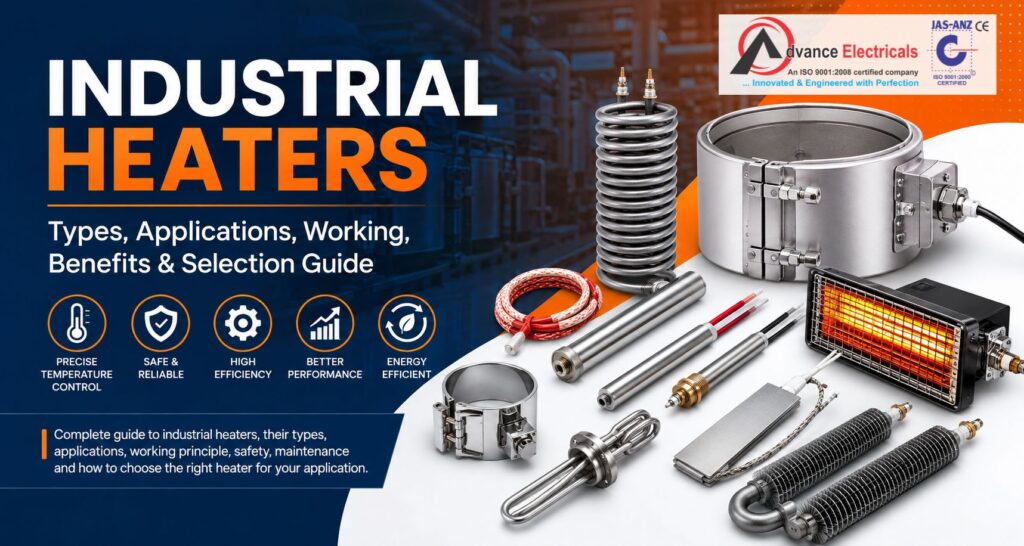
Common industrial heating equipment includes:
- Cartridge heaters
- Band heaters
- Coil heaters
- Nozzle heaters
- Tubular heaters
- Strip heaters
- Infrared heaters
- Immersion heaters
- Drum heaters
- Furnace heaters
- Hot runner heaters
- Panel space heaters
The correct heater depends on factors such as operating temperature, wattage, voltage, installation space, heating medium, material, and required temperature accuracy.
How Do Industrial Heaters Work?
The basic working principle of an electric industrial heater is based on electrical resistance heating.
When electrical current passes through a resistive heating element, electrical energy is converted into heat.
The basic process can be explained as:
Electrical Energy → Heating Element → Heat Generation → Heat Transfer → Controlled Temperature
The generated heat can reach the target material through different methods.
1. Conduction
Heat is transferred through direct contact between the heating element and the material being heated.
Cartridge heaters, band heaters, and some tubular heaters commonly use conduction as an important heat-transfer method.
2. Convection
Heat is transferred through moving air or another fluid.
Air heaters and some tubular heating systems are commonly used where air or fluids need to be heated.
3. Radiation
Heat is transferred through electromagnetic radiation without requiring direct physical contact.
Infrared heaters are commonly used for applications where radiant heating is required.
The efficiency of an industrial heating system depends not only on the heater itself but also on heater sizing, installation, insulation, temperature control, and heat-loss management.
Major Types of Industrial Heaters
Different manufacturing processes require different heating methods. Understanding the major types of industrial heaters can help engineers and plant managers select the appropriate solution.
1. Cartridge Heaters
Cartridge heaters are compact cylindrical heating elements commonly used for direct-contact heating.
They are frequently used in:
- Injection molding machines
- Dies
- Molds
- Packaging equipment
- Hot plates
- Sealing equipment
- Industrial tooling
For applications requiring high watt density and compact construction, high-density cartridge heaters can be an effective option.
2. Band Heaters
Band heaters are designed to heat cylindrical components from the outside.
They are widely used in plastic processing machinery, especially around barrels and cylindrical surfaces.
Common applications include:
- Injection molding machines
- Extrusion machines
- Plastic processing equipment
- Cylindrical vessels
Ceramic band heaters can provide efficient heating for applications where high operating temperatures and good insulation are required.
3. Coil Heaters
Coil heaters are flexible heating elements that can be formed into different shapes according to the application.
They are often used where localized heating and compact installation are required.
Applications can include:
- Dies
- Nozzles
- Plastic processing equipment
- Extrusion systems
- Industrial machinery
4. Nozzle Heaters
Nozzle heaters are designed specifically for heating machine nozzles and similar cylindrical components.
They are commonly used in plastic injection molding applications where maintaining the required temperature around the nozzle is important for consistent material flow.
5. Tubular Heaters
Tubular heaters are versatile heating elements that can be manufactured in different shapes and configurations.
They are used for heating:
- Air
- Liquids
- Ovens
- Tanks
- Industrial equipment
- Process machinery
Their flexible construction makes them suitable for many industrial heating applications.
6. Infrared Heaters
Infrared heaters transfer heat primarily through infrared radiation.
Unlike conventional contact heating, infrared heating can transfer energy to a target surface without direct physical contact.
They can be used in applications such as:
- Plastic forming
- Drying
- Coating
- Packaging
- Surface heating
- Industrial processing
7. Immersion Heaters
Immersion heaters are designed to heat liquids by directly immersing the heating element into the liquid.
They can be used for heating:
- Water
- Oils
- Chemical solutions
- Process liquids
- Storage tanks
The heater material and construction should be selected according to the liquid being heated and the operating conditions.
8. Strip Heaters
Strip heaters are flat heating elements designed for surface heating and other applications where a flat heating source is required.
They can be used in:
- Industrial machinery
- Sealing equipment
- Ovens
- Heating plates
- Packaging equipment
9. Drum Heaters
Drum heaters are used to heat materials stored in drums and containers.
They can help maintain the required temperature or reduce the viscosity of materials that become difficult to handle at lower temperatures.
Typical applications include industrial processing, chemical handling, oils, and other temperature-sensitive materials.
10. Furnace Heaters
Furnace heaters are designed for high-temperature heating applications.
They can be used in industrial furnaces, ovens, heat-treatment equipment, and other systems where controlled high-temperature heating is required.
11. Hot Runner Heaters
Hot runner heaters are used in plastic injection molding systems to maintain the temperature of molten plastic within hot runner components.
Accurate and consistent heating can help maintain material flow and reduce temperature variations within the system.
12. Panel Space Heaters
Panel space heaters are used inside electrical panels and control cabinets to help control condensation and maintain suitable internal temperatures.
They are particularly useful in environments where temperature and moisture can affect sensitive electrical components.
Industrial Heater Applications
Industrial heaters are used across many manufacturing and processing industries.
The correct heating solution depends on the material being heated, required temperature, heating method, available installation space, and process requirements.
Plastic Processing
Plastic processing is one of the major applications for industrial heating systems.
Heaters are used in:
- Injection molding
- Extrusion
- Blow molding
- Hot runner systems
- Plastic sealing
- Thermoforming
Common heater types include cartridge heaters, band heaters, nozzle heaters, coil heaters, and hot runner heaters.
Chemical Processing
Industrial heaters can be used for controlled heating of liquids, chemicals, tanks, pipes, and process equipment.
Immersion heaters and tubular heaters are commonly considered for liquid and process heating applications.
Food Processing
Heating systems can be used for controlled heating, drying, cooking, sealing, and other food-processing operations.
The heater design and materials should be selected according to the required temperature and applicable process conditions.
Packaging
Heating is used in many packaging processes, including sealing and forming.
Strip heaters, cartridge heaters, infrared heaters, and other specialized heating elements can be used depending on the equipment.
Automotive Manufacturing
Industrial heating equipment can be used in various automotive manufacturing processes, including drying, curing, forming, and component processing.
Pharmaceutical Manufacturing
Controlled heating is important in pharmaceutical manufacturing and processing. Heating equipment must be selected according to process temperature, material compatibility, cleanliness requirements, and control requirements.
Metal Processing
High-temperature industrial heaters are used in applications such as furnaces, ovens, heat treatment, and other metal-processing operations.
How to Choose the Right Industrial Heater
Selecting an industrial heater should not be based only on price or maximum temperature.
The heater should match the actual requirements of the application.
1. Determine the Required Temperature
Start by identifying the minimum, normal, and maximum operating temperature required by the process.
The heater’s operating temperature capability should be suitable for the application.
2. Calculate the Required Wattage
The required wattage depends on factors such as:
- Material mass
- Starting temperature
- Target temperature
- Heating time
- Heat losses
- Insulation
- Environmental conditions
An undersized heater may take too long to reach the required temperature, while an incorrectly oversized heater can create unnecessary temperature-control challenges.
3. Check Voltage Requirements
Select a heater that matches the available electrical supply and system design.
Common considerations include voltage, phase, current, and electrical connection requirements.
4. Consider Installation Space
The available space can determine which heater design is practical.
For example, compact spaces may require cartridge or coil heaters, while cylindrical surfaces may be better suited to band or nozzle heaters.
5. Identify the Heating Medium
Determine whether you need to heat:
- Solid materials
- Air
- Water
- Oil
- Chemicals
- Plastic
- Metal surfaces
The heating medium strongly influences heater selection.
6. Consider Material Compatibility
The heating element’s construction and sheath material should be compatible with the operating environment.
Factors such as moisture, chemicals, corrosion, temperature, and mechanical conditions should be considered.
7. Select the Appropriate Temperature Control
Applications requiring precise temperature control may need sensors such as thermocouples or RTDs combined with suitable temperature controllers.
Industrial Heater Energy Efficiency
Energy efficiency is an important consideration when operating industrial heating equipment.
An inefficient heating system can lose energy through poor insulation, incorrect heater sizing, excessive temperature settings, and uncontrolled heat loss.
Ways to Improve Industrial Heater Efficiency
Use the Correct Heater Size
A properly sized heater can provide the required heat without unnecessary energy consumption.
Improve Insulation
Good insulation reduces heat loss from heated surfaces and can help maintain process temperature.
For plastic processing equipment, insulation jackets can help reduce heat loss from machine barrels and other heated surfaces.
Maintain Accurate Temperature Control
Temperature controllers can prevent unnecessary overheating and help maintain the desired process temperature.
Reduce Heat Loss
Inspect exposed heated surfaces, gaps, damaged insulation, and other areas where heat may escape.
Maintain the Heater
A poorly maintained heating element may provide inconsistent performance and can affect overall process efficiency.
Industrial Heater Temperature Control
Temperature control is essential for maintaining consistent industrial processes.
A heating system typically combines a heating element with a temperature sensor and controller.
Common Temperature-Control Components
Heating Element: Generates heat.
Thermocouple: Measures temperature.
Temperature Controller: Compares the measured temperature with the required set point and controls heater operation.
SSR or Contactor: Switches electrical power to the heating element according to the control system.
For applications requiring accurate temperature measurement, the correct thermocouple type, location, and installation are important.
Why Accurate Temperature Control Matters
Poor temperature control can result in:
- Uneven heating
- Product quality problems
- Material degradation
- Longer processing times
- Excessive energy consumption
- Heater failure
A properly designed control system helps maintain stable operating conditions.
Industrial Heater Safety
Industrial heaters operate at high temperatures and can involve significant electrical power. Proper installation and safety practices are therefore essential.
Important Industrial Heater Safety Practices
1. Use the Correct Heater
Select a heater designed for the intended application, temperature, voltage, and environment.
2. Follow Electrical Safety Requirements
Electrical connections should be properly designed, insulated, and protected.
3. Use Temperature Protection
Where required, use temperature controllers, thermostats, thermal cut-outs, or independent over-temperature protection.
4. Provide Proper Insulation
Insulation can reduce heat loss and help protect nearby components and personnel from hot surfaces.
5. Prevent Overheating
Do not operate heaters outside their specified operating conditions.
6. Inspect Electrical Connections
Loose terminals and damaged wiring can create electrical and heating problems.
7. Keep the Heating Area Suitable
Avoid contact between high-temperature surfaces and materials that are not suitable for the operating temperature.
8. Follow Manufacturer Recommendations
Always follow the heater manufacturer’s installation, operating, and maintenance instructions.
Industrial Heater Maintenance
Regular maintenance can help improve heater performance and identify potential problems before they result in production downtime.
Recommended Maintenance Checks
- Inspect heating elements regularly.
- Check electrical terminals and connections.
- Measure resistance where appropriate.
- Inspect wiring for damage.
- Check temperature sensors.
- Inspect insulation.
- Look for signs of overheating.
- Check for contamination or material buildup.
- Verify temperature-controller operation.
- Replace damaged heating elements when required.
Common Signs of Heater Problems
A heater may require inspection or replacement if you notice:
- Slow heating
- Uneven temperature
- Frequent electrical tripping
- Unexpected temperature fluctuations
- Visible heater damage
- Increased heating time
- Higher-than-normal energy consumption
Preventive maintenance is generally better than waiting for a heater to fail during production.
Benefits of Using the Right Industrial Heater
Choosing the appropriate industrial heating solution can provide several operational benefits.
Better Temperature Control
A properly selected heater combined with an appropriate control system can provide more consistent process temperatures.
Improved Product Quality
Stable heating conditions can help maintain consistent manufacturing processes.
Better Energy Management
Correct heater sizing, insulation, and temperature control can help reduce unnecessary heat loss.
Improved Equipment Performance
A heater designed for the application can provide reliable heating without unnecessary stress on the equipment.
Reduced Downtime
Reliable heating equipment and preventive maintenance can help reduce unexpected production interruptions.
Longer Heater Life
Operating a heater within its suitable temperature, watt density, and electrical conditions can help improve service life.
Industrial Heater Manufacturers: What Should You Look For?
When choosing an industrial heater manufacturer, price should not be the only consideration.
Look for a manufacturer or supplier that can understand your application and recommend an appropriate heating solution.
Consider:
- Product range
- Manufacturing capability
- Heater customization
- Material options
- Temperature requirements
- Wattage and voltage options
- Quality control
- Technical support
- Application experience
- After-sales support
A manufacturer with a broad product range can also make it easier to select the right heating technology for different applications.
Advance Electrical provides industrial heating solutions for a range of manufacturing and processing applications.
How to Select the Right Industrial Heater: Quick Checklist
Before ordering an industrial heater, collect the following information:
| Requirement | Information to Confirm |
| Application | What needs to be heated? |
| Temperature | Required operating temperature |
| Wattage | Required heating power |
| Voltage | Available electrical supply |
| Dimensions | Available installation space |
| Heating Method | Conduction, convection, or radiation |
| Material | Material/environment being heated |
| Control | Required temperature accuracy |
| Environment | Moisture, chemicals, dust, etc. |
| Installation | Mounting and electrical connection |
| Operating Cycle | Continuous or intermittent operation |
| Safety | Required protection systems |
Providing these details to the manufacturer can make heater selection easier and reduce the possibility of selecting an unsuitable heating element.
Conclusion
Industrial heaters play an important role in modern manufacturing and processing operations. From plastic injection molding and extrusion to liquid heating, packaging, furnaces, and industrial equipment, the right heating solution can help maintain stable temperatures and reliable production.
There is no single industrial heater that is suitable for every application. Cartridge heaters, band heaters, coil heaters, nozzle heaters, tubular heaters, infrared heaters, immersion heaters, strip heaters, drum heaters, furnace heaters, and hot runner heaters are designed for different heating requirements.
Before selecting an industrial heater, evaluate the required temperature, wattage, voltage, dimensions, heating medium, installation conditions, temperature-control requirements, insulation, and safety requirements.
Selecting the right heater and maintaining it properly can help improve heating performance, reduce unnecessary energy losses, support consistent product quality, and minimize production downtime.
If you need help selecting the right heating solution for your industrial application, contact Advance Electrical with your application details, required temperature, dimensions, voltage, and wattage requirements.
Also Read: Top 10 Industrial Heater Types Used in Modern Manufacturing Industries
Frequently Asked Questions About Industrial Heaters
An industrial heater is a heating device designed to generate and transfer heat for manufacturing, processing, machinery, equipment, tanks, ovens, furnaces, and other industrial applications.
Common types include cartridge heaters, band heaters, coil heaters, nozzle heaters, tubular heaters, infrared heaters, immersion heaters, strip heaters, drum heaters, furnace heaters, and hot runner heaters.
Most electric industrial heaters use resistance heating. Electrical current passes through a resistive heating element, converting electrical energy into heat.
Consider the required temperature, wattage, voltage, dimensions, heating medium, installation space, material compatibility, temperature-control requirements, and operating environment.
Industrial heater efficiency depends on heater design, sizing, insulation, temperature control, operating conditions, and heat losses. Properly designed systems can significantly reduce unnecessary energy consumption.
Accurate temperature control helps maintain consistent process conditions, reduce overheating, improve product quality, and manage energy consumption.
Maintenance frequency depends on the heater type, application, operating temperature, duty cycle, and environment. Regular inspection is recommended to identify electrical, mechanical, and heating problems early.
Many industrial heating systems can be customized according to dimensions, wattage, voltage, shape, material, terminal configuration, and application requirements. The available customization depends on the heater type and manufacturer.