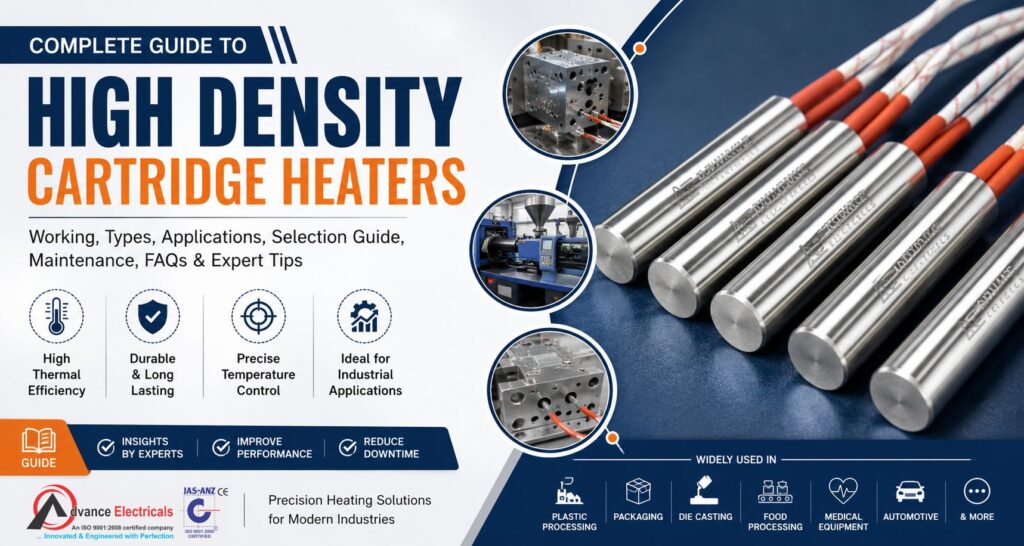
Modern manufacturing industries rely on precision heating systems to maintain production quality, reduce energy consumption, and improve operational efficiency. Among the various industrial heating solutions available today, High Density Cartridge Heaters have become one of the most reliable options for delivering concentrated and uniform heat in compact spaces.
Whether it is plastic processing, packaging machinery, die casting, food processing, medical equipment, semiconductor manufacturing, or aerospace applications, cartridge heaters play a vital role in maintaining precise process temperatures.
As industries continue moving toward automation and high-speed production, selecting the right heating element has become more important than ever. Choosing an inefficient heater can lead to higher energy consumption, inconsistent temperatures, frequent machine downtime, and increased maintenance costs.
This blog explains everything you need to know about High Density Cartridge Heaters—from their working principle and construction to applications, maintenance, buying tips, and selection criteria.
If you are looking for reliable High Density Cartridge Heater Manufacturers, this guide will also help you understand the factors that distinguish a high-quality industrial heater from a standard one.
What is a High Density Cartridge Heater?
A High Density Cartridge Heater is a cylindrical electric heating element designed to deliver high watt density within a compact metal sheath. It converts electrical energy into heat and transfers it directly to molds, dies, platens, hot runner systems, sealing equipment, and industrial machinery through conduction.
Unlike standard heating elements, high-density cartridge heaters are engineered for applications requiring:
- Fast heating
- High operating temperatures
- Uniform heat distribution
- Compact installation
- Long service life
- High thermal efficiency
The heater is inserted into a precisely machined hole where it makes close contact with the surrounding metal surface. This close fit minimizes heat loss and ensures efficient heat transfer.
High Density Cartridge Heaters are available in a wide range of diameters, lengths, voltages, wattages, and lead wire configurations, making them suitable for custom industrial applications.
Why High Density Cartridge Heaters Are Preferred in Modern Industries
Industrial processes demand consistent temperatures to maintain product quality and production efficiency. Traditional heating methods often suffer from slow response times and uneven heating.
High Density Cartridge Heaters address these challenges by providing:
- Rapid temperature rise
- Excellent thermal conductivity
- Compact design
- Reduced energy losses
- High durability
- Reliable long-term performance
- Accurate temperature control
These advantages make them one of the most widely used industrial heating solutions across manufacturing industries worldwide.
How Does a High Density Cartridge Heater Work?
The working principle of a High Density Cartridge Heater is based on electrical resistance heating.
When electric current flows through the resistance wire inside the heater, electrical energy is converted into thermal energy.
The heat generated by the resistance coil passes through highly compacted magnesium oxide insulation before reaching the stainless steel sheath.
The stainless steel sheath then transfers heat directly to the surrounding metal component.
Because magnesium oxide provides excellent thermal conductivity while maintaining electrical insulation, almost all generated heat reaches the application efficiently.
This design allows cartridge heaters to achieve very high operating temperatures while maintaining electrical safety.
Construction of High Density Cartridge Heater
A High Density Cartridge Heater consists of several carefully engineered components that work together to ensure efficient heating performance.
1. Resistance Heating Coil
The heating coil is manufactured using high-grade nickel-chromium resistance wire.
Its primary function is converting electrical energy into heat.
Premium quality resistance wire offers:
- Stable resistance
- Uniform heating
- Long operating life
- High temperature capability
2. Magnesium Oxide Insulation
Magnesium Oxide (MgO) is one of the most important components inside a cartridge heater.
It provides two major benefits:
- Excellent electrical insulation
- High thermal conductivity
The MgO powder is compacted under high pressure to eliminate air gaps.
This improves:
- Heat transfer
- Heater efficiency
- Mechanical strength
3. Stainless Steel Sheath
The outer sheath protects the internal heating element from:
- Corrosion
- Moisture
- Mechanical damage
- Chemical exposure
- High temperatures
Depending on the application, manufacturers may use:
- SS304
- SS316
- Incoloy
- Special alloys
4. Lead Wires
Lead wires connect the heater to the electrical supply.
Various lead wire configurations are available depending on:
- Temperature
- Installation space
- Machine design
- Environmental conditions
5. End Seals
High-quality sealing protects internal components from:
- Oil
- Water
- Dust
- Chemical vapors
Proper sealing significantly increases heater lifespan.
Types of High Density Cartridge Heaters
Different industrial applications require different cartridge heater designs.
The most common types include:
Standard Cartridge Heaters
Suitable for general industrial heating applications.
Typical Uses:
- Packaging
- Plastic machinery
- General manufacturing
High Watt Density Cartridge Heaters
Designed for applications requiring rapid heat transfer.
Suitable for:
- Injection molding
- Hot runner systems
- Die casting
Built-in Thermocouple Cartridge Heaters
These heaters include an integrated thermocouple for accurate temperature monitoring.
Benefits include:
- Better temperature control
- Improved automation
- Reduced installation complexity
Split Sheath Cartridge Heaters
These heaters provide improved contact with drilled holes by expanding slightly after installation.
Advantages include:
- Better heat transfer
- Lower energy loss
- Improved efficiency
Custom Cartridge Heaters
Manufactured according to customer specifications, including:
- Diameter
- Length
- Voltage
- Wattage
- Lead exit
- Mounting style
- Terminal type
Custom heaters are ideal for OEM machinery manufacturers and specialized industrial equipment.
Key Features of High Density Cartridge Heaters
Modern High Density Cartridge Heaters are designed to deliver superior performance under demanding industrial conditions. Their compact construction and efficient heat transfer make them suitable for continuous operation in applications where precision temperature control is critical.
Some of the key features include:
- High watt density for rapid heating
- Uniform heat distribution
- Compact cylindrical design
- Excellent thermal conductivity
- Stainless steel construction
- Corrosion resistance
- High operating temperature capability
- Long service life
- Energy-efficient performance
- Custom dimensions available
- Easy installation
- Low maintenance requirements
- Compatible with temperature controllers
- Reliable performance in continuous-duty applications
These features make cartridge heaters one of the most preferred electric heating solutions for modern manufacturing industries.
Key Advantages of High Density Cartridge Heaters
Industrial manufacturers prefer High Density Cartridge Heaters because they deliver precise, efficient, and reliable heating even in demanding production environments. Compared to conventional heating solutions, they provide better heat transfer, faster response times, and longer operational life.
Below are the major advantages that make them a preferred choice across industries.
1. Fast Heating Performance
High Density Cartridge Heaters are designed with higher watt density, allowing them to reach operating temperatures quickly. This reduces machine warm-up time and improves production efficiency.
2. Uniform Heat Distribution
The compacted Magnesium Oxide insulation ensures even heat transfer throughout the heater, minimizing hot spots and maintaining consistent process temperatures.
3. Energy Efficiency
Efficient heat transfer means less energy is wasted. Properly installed cartridge heaters consume less power while delivering higher thermal performance.
4. Compact Design
Their cylindrical shape allows installation in limited spaces where other industrial heaters cannot be used.
5. Long Service Life
Premium materials, precise manufacturing, and high-quality insulation contribute to a longer operating life and reduced replacement costs.
6. Easy Installation
Cartridge heaters are easy to install in accurately machined holes, making maintenance and replacement simple.
7. Custom Manufacturing
Manufacturers can customize:
- Diameter
- Length
- Voltage
- Wattage
- Lead wire type
- Lead exit position
- Sensor integration
- Mounting options
This flexibility makes them suitable for OEM equipment and specialized industrial machinery.
Technical Specifications
| Parameter | Typical Range |
| Diameter | 3 mm – 25 mm |
| Length | 20 mm – 500 mm+ |
| Voltage | 12V – 480V |
| Watt Density | Up to 40 W/cm² (application dependent) |
| Operating Temperature | Up to approximately 750°C (depending on design) |
| Sheath Material | SS304, SS316, Incoloy |
| Insulation | High Purity Magnesium Oxide |
| Heating Wire | Nickel Chromium (NiCr) |
| Thermocouple Option | J Type / K Type |
| Lead Wire | Fiberglass, PTFE, High Temperature Cable |
Industrial Applications of High Density Cartridge Heaters
One of the biggest reasons cartridge heaters are widely used is their versatility. They are suitable for heating metal components directly and maintaining precise temperatures in industrial processes.
Injection Moulding Machines
Cartridge heaters maintain accurate mold temperatures, improving product quality and reducing cycle time.
Hot Runner Systems
They provide consistent heating inside hot runner manifolds, preventing plastic from solidifying during molding.
Plastic Extrusion Machines
Used in dies and tooling to maintain uniform material flow.
Packaging Equipment
Heat sealing machines use cartridge heaters to ensure reliable and consistent sealing.
Die Casting
Cartridge heaters maintain die temperatures, reducing defects and improving casting quality.
Rubber Processing
They help maintain precise temperatures during molding and vulcanization.
Food Processing Equipment
Used in heating plates, sealing bars, and processing machinery where controlled heating is essential.
Pharmaceutical Machinery
Supports controlled heating for packaging, sealing, and specialized processing equipment.
Medical Equipment
Many laboratory and medical devices use cartridge heaters for accurate temperature control.
Textile Machinery
Used for heat-setting and specialized industrial textile processes.
Printing Machines
Provide controlled heating in industrial printing and laminating systems.
Semiconductor Industry
Precision heating is critical during semiconductor manufacturing and testing processes.
Aerospace Components
Used in tooling, fixtures, and testing equipment requiring stable temperatures.
Laboratory Equipment
Installed in testing instruments, reactors, and scientific research equipment.
Automation Systems
Industrial automation equipment often integrates cartridge heaters for precision heating.
Industries That Use High Density Cartridge Heaters
These heaters are widely used in:
- Plastic Processing Industry
- Packaging Industry
- Automotive Manufacturing
- Chemical Industry
- Pharmaceutical Industry
- Food Processing Industry
- Rubber Industry
- Textile Industry
- Electronics Manufacturing
- Medical Equipment Manufacturing
- Aerospace Industry
- Metal Processing
- Machine Tool Industry
- Printing Industry
- Research Laboratories
Cartridge Heater vs Tubular Heater
Choosing the right heater depends on the application. The table below highlights the differences between High Density Cartridge Heaters and Tubular Heaters.
| Feature | High Density Cartridge Heater | Tubular Heater |
| Shape | Cylindrical | Straight or bent |
| Heat Transfer | Direct conduction | Air, liquid, or surface heating |
| Installation | Precision drilled hole | Mounted with brackets or flanges |
| Response Time | Very Fast | Moderate |
| Watt Density | High | Medium to High |
| Compact Design | Excellent | Good |
| Custom Sizes | Yes | Yes |
| Industrial Applications | Molds, dies, platens | Tanks, ovens, ducts, air heaters |
Cartridge Heater vs Coil Heater
Although both are electric heating elements, they are designed for different industrial applications.
| Feature | Cartridge Heater | Coil Heater |
| Design | Solid cylindrical heater | Flexible coiled heater |
| Installation | Inside drilled holes | Wrapped around nozzles |
| Heating Method | Conduction | Surface heating |
| Common Industry | Molds & Dies | Plastic Injection Moulding |
| Temperature Control | Excellent | Excellent |
| Space Requirement | Compact hole | Around cylindrical surfaces |
Cartridge Heater vs Hot Runner Heater
| Feature | Cartridge Heater | Hot Runner Heater |
| Primary Application | General industrial heating | Plastic molding systems |
| Heat Distribution | Localized | Manifold and nozzle heating |
| Installation | Metal holes | Hot runner assemblies |
| Temperature Accuracy | High | Very High |
| OEM Customization | Extensive | Extensive |
Role of Thermocouples with Cartridge Heaters
Temperature control is only as effective as the sensor monitoring it. High-quality thermocouples help maintain accurate temperatures, prevent overheating, and improve process consistency.
Benefits include:
- Accurate temperature measurement
- Better process control
- Reduced heater failure
- Improved product quality
- Increased energy efficiency
Many cartridge heaters can also be supplied with built-in thermocouples for applications requiring precise monitoring.
Why Industrial Heater Selection Matters
A cartridge heater is just one part of an industrial heating system. Selecting the correct heating technology for each application improves efficiency, extends equipment life, and reduces operating costs.
For applications such as tank heating, air heating, furnace systems, or process heating, other industrial heater types may be more suitable.
At Advance Electricals, we understand that every industrial process has unique heating requirements. Selecting the right cartridge heater is not simply about voltage or wattage—it involves considering factors such as operating temperature, hole tolerance, duty cycle, environmental conditions, and machine design.
As a manufacturer of industrial heating solutions, we recommend working closely with experienced engineers to ensure the heater is correctly specified for your application. A properly designed and installed cartridge heater can improve process efficiency, reduce downtime, and extend equipment life, while an incorrect selection may lead to overheating, premature failure, and unnecessary maintenance costs.
How to Choose the Right High Density Cartridge Heater
Selecting the correct High Density Cartridge Heater Manufacturers in India is one of the most important decisions for achieving consistent heating performance, reducing maintenance costs, and extending equipment life. Many heater failures occur not because of manufacturing defects, but because the wrong heater is selected for the application.
Below are the key factors that should be evaluated before purchasing a cartridge heater.
1. Operating Temperature
The first step is identifying the maximum operating temperature required by your process.
Different industrial applications demand different temperature ranges.
| Application | Typical Temperature Range |
| Plastic Processing | 180°C – 350°C |
| Packaging Machines | 120°C – 300°C |
| Hot Runner Systems | 250°C – 450°C |
| Die Casting | 300°C – 600°C |
| Food Processing | 100°C – 250°C |
Always select a heater that is designed to operate safely within your required temperature range.
2. Correct Diameter
Diameter plays a critical role in heat transfer.
A heater that is too small will leave air gaps, reducing heat transfer and increasing sheath temperature.
A heater that is too large may be difficult to install or may damage the mounting hole.
Professional manufacturers recommend machining the hole with the proper tolerance to achieve optimal thermal contact.
3. Heater Length
The heating length should match the heated zone.
A heater that is too short may create cold spots, while an excessively long heater may waste energy and heat unnecessary areas.
4. Watt Density Selection
Watt density refers to the amount of power generated per unit surface area.
Choosing the correct watt density helps prevent overheating and extends heater life.
Low Watt Density
Suitable for:
- Continuous heating
- Sensitive materials
- Long operating cycles
Medium Watt Density
Suitable for:
- General industrial applications
- Standard machinery
High Watt Density
Suitable for:
- Fast heating
- Injection moulding
- Hot runner systems
- Die casting
- High-speed production lines
5. Voltage Selection
Industrial cartridge heaters are available in various voltages, including:
- 12V
- 24V
- 48V
- 110V
- 230V
- 240V
- 380V
- 415V
- 480V
Using the correct voltage ensures efficient performance and helps prevent premature heater failure.
6. Sheath Material
The sheath protects the heating element from corrosion, oxidation, and harsh industrial environments.
Common sheath materials include:
- Stainless Steel 304
- Stainless Steel 316
- Incoloy
- Special Alloy Steel
The appropriate material depends on operating temperature and the surrounding environment.
7. Lead Wire Selection
Lead wires must withstand the application’s operating temperature.
Common options include:
- Fiberglass insulated wires
- PTFE insulated wires
- High-temperature ceramic leads
- Stainless steel braided cables
8. Built-in Thermocouple Requirement
Applications requiring precise temperature control often use built-in thermocouples.
Benefits include:
- Real-time temperature monitoring
- Improved process accuracy
- Reduced overheating
- Better automation compatibility
Installation Guide
Proper installation significantly impacts heater performance and lifespan.
Step 1 – Machine the Hole Correctly
The mounting hole should be accurately drilled and reamed.
Poor machining results in:
- Air gaps
- Heat loss
- Uneven heating
- Reduced heater life
Step 2 – Clean the Hole
Remove:
- Dust
- Rust
- Oil
- Burrs
- Metal chips
before installing the heater.
Step 3 – Insert Carefully
Avoid:
- Hammering
- Twisting lead wires
- Excessive force
Improper installation can damage internal components.
Step 4 – Secure Electrical Connections
Loose electrical connections generate additional heat and may reduce heater performance.
Ensure all terminals are tight and correctly insulated.
Step 5 – Verify Temperature Control
Always test:
- Temperature controller
- Thermocouple
- Power supply
- Wiring
before starting production.
Common Installation Mistakes
Many heater failures are caused by installation errors rather than product defects.
Avoid these common mistakes:
- Oversized mounting holes
- Undersized holes
- Using damaged heaters
- Running heaters without proper heat transfer
- Operating above the rated temperature
- Incorrect voltage supply
- Improper wiring
- Poor temperature control
- Moisture entering the heater
- Excessive vibration
Maintenance Guide
Routine maintenance helps maximize heater life and reduce unexpected downtime.
Daily Inspection
Check:
- Electrical connections
- Surface cleanliness
- Temperature consistency
- Controller operation
Weekly Inspection
Inspect:
- Lead wires
- Insulation condition
- Terminal tightness
- Sensor performance
Monthly Inspection
Verify:
- Heater resistance
- Insulation resistance
- Hole condition
- Mounting fit
- Temperature calibration
Preventive Maintenance Checklist
Clean heater surfaces regularly
Avoid moisture exposure
Check insulation resistance
Replace damaged lead wires
Inspect connectors
Verify controller accuracy
Monitor operating temperature
Prevent overheating
Remove carbon deposits
Replace worn heaters before failure
Common Cartridge Heater Problems and Solutions
| Problem | Possible Cause | Recommended Solution |
| Heater not heating | Broken resistance wire | Replace heater |
| Uneven heating | Poor hole tolerance | Re-machine the hole |
| Heater burns out quickly | Excessive watt density | Select correct watt density |
| Low temperature | Incorrect voltage | Verify power supply |
| Frequent failure | Loose electrical connections | Tighten and inspect terminals |
| Hot spots | Air gap between heater and hole | Improve fit and installation |
| Insulation failure | Moisture or contamination | Replace heater and improve sealing |
| Slow heating | Incorrect heater specification | Select a properly rated heater |
Best Practices to Increase Heater Life
Following these best practices can significantly improve performance and reduce maintenance costs:
- Use the correct hole tolerance.
- Avoid dry firing the heater.
- Use a temperature controller for stable operation.
- Prevent contamination from oil, water, and dust.
- Choose the appropriate watt density.
- Perform regular inspections.
- Replace damaged lead wires promptly.
- Use genuine spare parts.
- Install the heater according to the manufacturer’s guidelines.
- Maintain stable electrical voltage.
How to Select a Reliable High Density Cartridge Heater Manufacturer
The performance of a cartridge heater depends not only on its design but also on the expertise and quality standards of the manufacturer.
Before selecting a supplier, evaluate:
- Years of manufacturing experience
- Ability to provide custom designs
- Quality of raw materials
- Precision manufacturing process
- Product testing procedures
- Availability of technical support
- Delivery capabilities
- Consistent product quality
- Industry certifications
- After-sales support
A trusted manufacturer should understand your application requirements and recommend the most suitable heater rather than offering a one-size-fits-all solution.
Why Choose Advance Electricals?
When selecting an industrial heating partner, experience, engineering expertise, and consistent product quality are critical.
Advance Electricals manufactures high-quality industrial heating solutions designed for demanding industrial applications. Our team works closely with OEMs, machine builders, and manufacturing industries to deliver cartridge heaters tailored to specific operating conditions.
What We Offer
- Custom High Density Cartridge Heaters
- Precision Engineering
- High-Quality Raw Materials
- Consistent Heating Performance
- Fast Production & Delivery
- Technical Application Support
- Reliable After-Sales Assistance
- Solutions for OEM and Industrial Applications
Whether your requirement is for plastic processing, packaging, hot runner systems, die casting, or custom industrial machinery, our engineers help you select the right heater for maximum efficiency and long service life.
Need a Custom High Density Cartridge Heater?
If you are looking for a dependable High Density Cartridge Heater Manufacturer in India, Advance Electricals offers customized heating solutions to meet your exact industrial requirements.
Contact our technical team today to discuss your application, operating conditions, voltage, wattage, dimensions, and customization needs. We will help you select the most suitable heating solution for reliable performance and long-term value.
Conclusion
High Density Cartridge Heaters are among the most efficient and reliable electric heating solutions for modern manufacturing. Their compact design, rapid heat transfer, and ability to maintain precise temperatures make them suitable for a wide range of industrial applications, from plastic processing and packaging to medical equipment and aerospace manufacturing.
However, achieving the best performance depends on selecting the correct heater specifications, ensuring proper installation, and following a preventive maintenance schedule. Partnering with an experienced manufacturer can help optimize energy efficiency, reduce downtime, and extend equipment life.
As manufacturing technologies continue to evolve, investing in high-quality, application-specific cartridge heaters remains a practical way to improve productivity and process consistency.
Why Choose Advance Electricals?
At Advance Electricals, we specialize in manufacturing reliable and customized industrial heating solutions for diverse industries. Our engineering team works closely with customers to understand their operating conditions and recommend the most suitable High Density Cartridge Heater for their application.
Why Industries Trust Advance Electricals
- Manufacturer-focused expertise
- Custom-built heating solutions
- High-quality raw materials
- Precision manufacturing
- Strict quality inspection
- Technical support from experienced engineers
- Fast response and delivery
- Solutions for OEMs and industrial users
Whether you need a standard cartridge heater or a fully customized solution, we are committed to delivering products that meet your performance, reliability, and efficiency requirements.
Contact Advance Electricals
If you’re looking for a trusted High Density Cartridge Heater Manufacturer, get in touch with Advance Electricals. Our team can help you select the right heating solution based on your machine design, operating temperature, voltage, wattage, and industrial application.
Frequently Asked Questions (FAQ)
A High Density Cartridge Heater is a cylindrical electric heating element designed to provide concentrated and uniform heat in a compact space. It is widely used in industrial machinery, molds, dies, packaging equipment, and plastic processing machines where accurate temperature control is required.
The heater works on the principle of electrical resistance. When current passes through a nickel-chromium resistance wire, heat is generated. This heat is transferred through compacted magnesium oxide insulation to the stainless steel sheath and then directly to the heated metal component.
The maximum operating temperature depends on the heater design, sheath material, watt density, and application. Custom-engineered cartridge heaters can be designed for demanding high-temperature industrial environments, but the recommended operating range should always follow the manufacturer’s specifications.
These heaters are commonly used in:
Plastic Processing
Injection Moulding
Packaging Industry
Food Processing
Pharmaceutical Equipment
Medical Equipment
Automotive Manufacturing
Die Casting
Semiconductor Manufacturing
Textile Industry
Printing Industry
Chemical Processing
The service life depends on operating conditions, installation quality, temperature control, and maintenance. A correctly selected and properly installed cartridge heater generally lasts significantly longer than one operating outside its design limits.
Common reasons include:
Incorrect watt density
Poor hole tolerance
Overheating
Wrong voltage
Moisture ingress
Loose electrical connections
Improper installation
Lack of preventive maintenance
Yes. Most industrial applications require customized heaters based on:
Diameter
Length
Voltage
Wattage
Lead Exit Position
Thermocouple Option
Heating Length
Sheath Material
Typical sheath materials include:
Stainless Steel 304
Stainless Steel 316
Incoloy
Special Alloy Materials
The selection depends on operating temperature and environmental conditions.
Magnesium Oxide provides excellent thermal conductivity while maintaining high electrical insulation. It improves heating efficiency and protects the resistance wire from electrical failure.
Watt density refers to the amount of power generated per unit surface area of the heater. Selecting the correct watt density is essential for efficient heat transfer and long service life.
In most industrial cases, damaged cartridge heaters are replaced rather than repaired because internal heating elements and insulation cannot usually be restored to original performance.
Store heaters in a clean and dry environment, away from moisture, dust, and corrosive chemicals. Proper storage helps maintain insulation quality and electrical performance.
Selection should consider:
Application
Operating Temperature
Hole Diameter
Heater Length
Voltage
Wattage
Watt Density
Environmental Conditions
Temperature Control Requirements
Consulting an experienced manufacturer ensures the heater is correctly specified for your process.
Cartridge heaters are primarily designed for installation inside precision-drilled holes to provide localized conductive heating. Tubular heaters are more versatile and are commonly used for heating air, liquids, tanks, ovens, ducts, and industrial process equipment.
A custom heater is designed to match the exact dimensions, voltage, wattage, operating temperature, and installation requirements of your equipment. This results in improved heat transfer, better energy efficiency, and a longer service life compared to using a standard-size heater.